Winnipeg, November 10, 2026: the full record
Everything that was said and counted on the day, in numbered paragraphs, from the photos of the walls and the recordings. For what was decided and what happens next, read the short report.
1 The day in brief
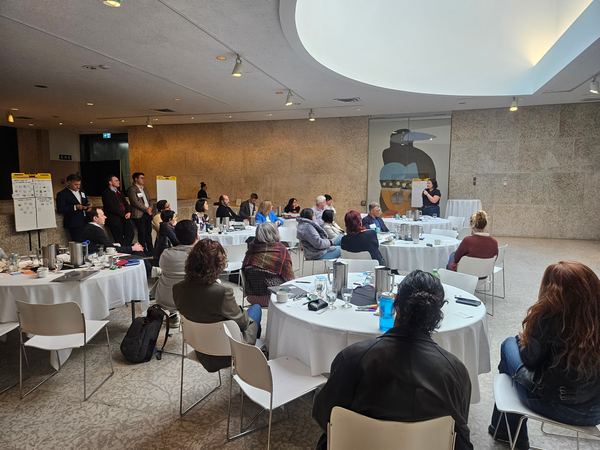
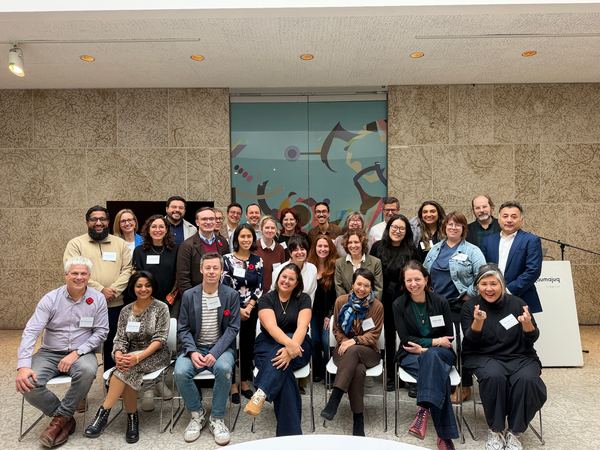
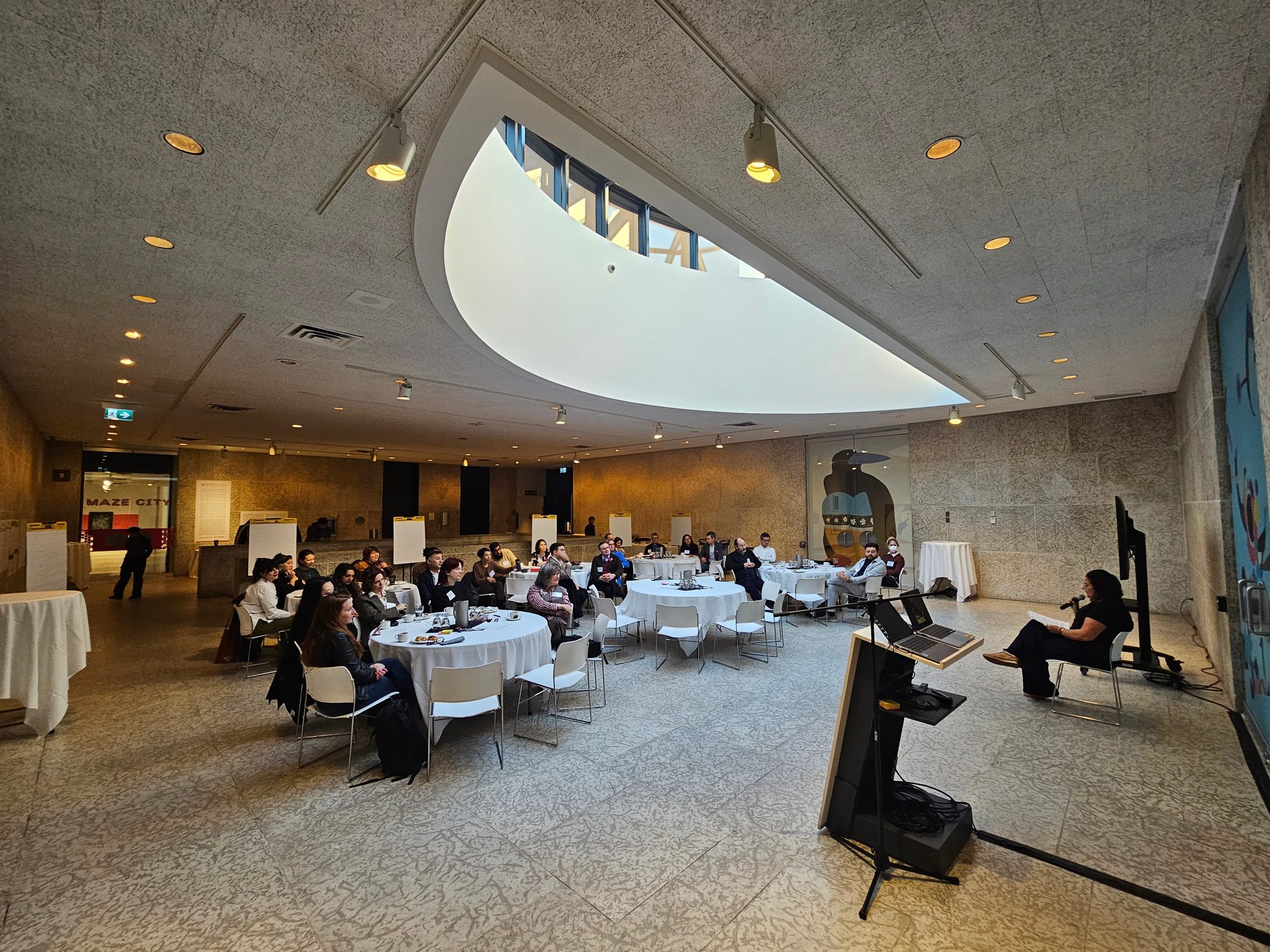
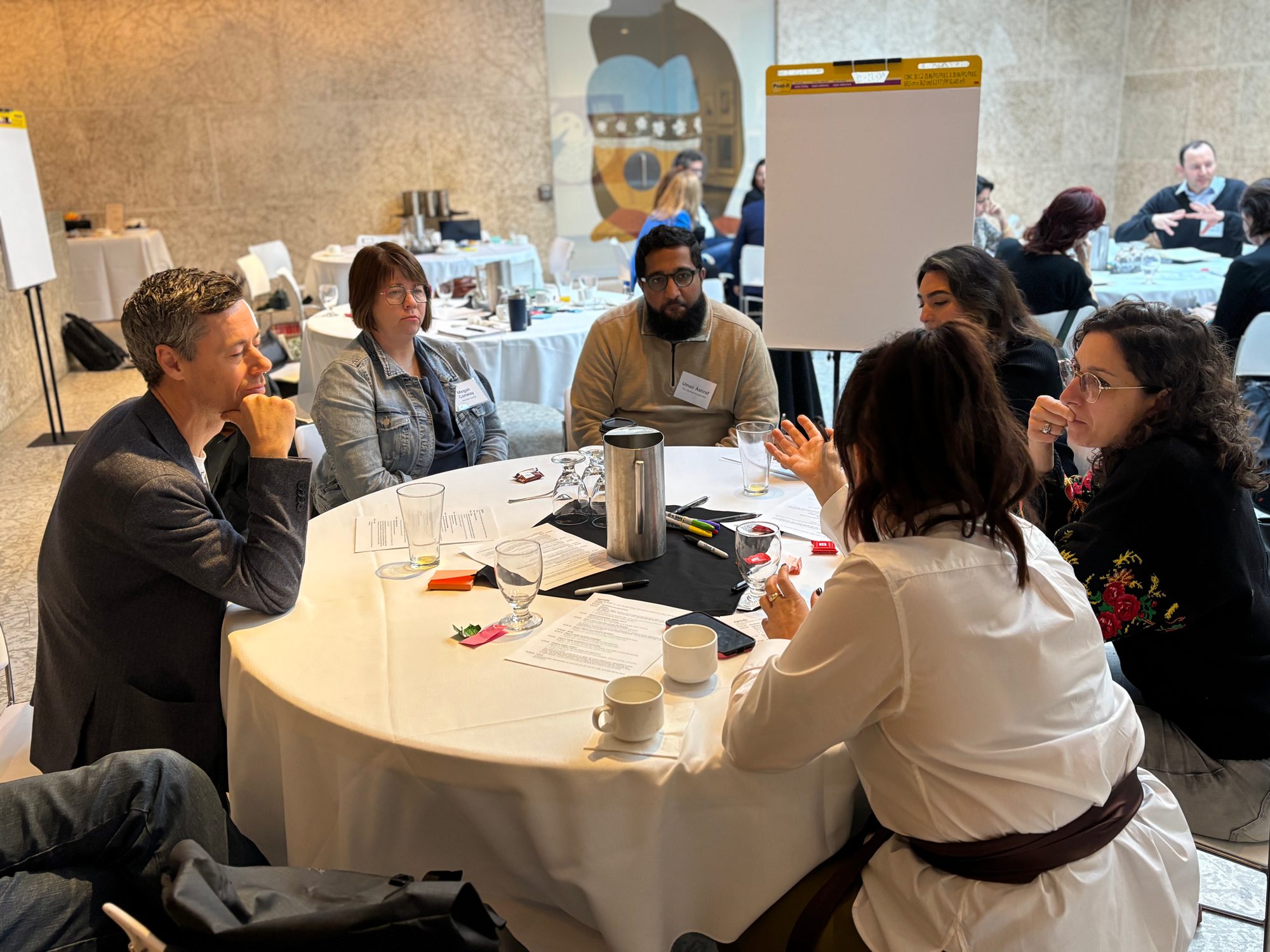
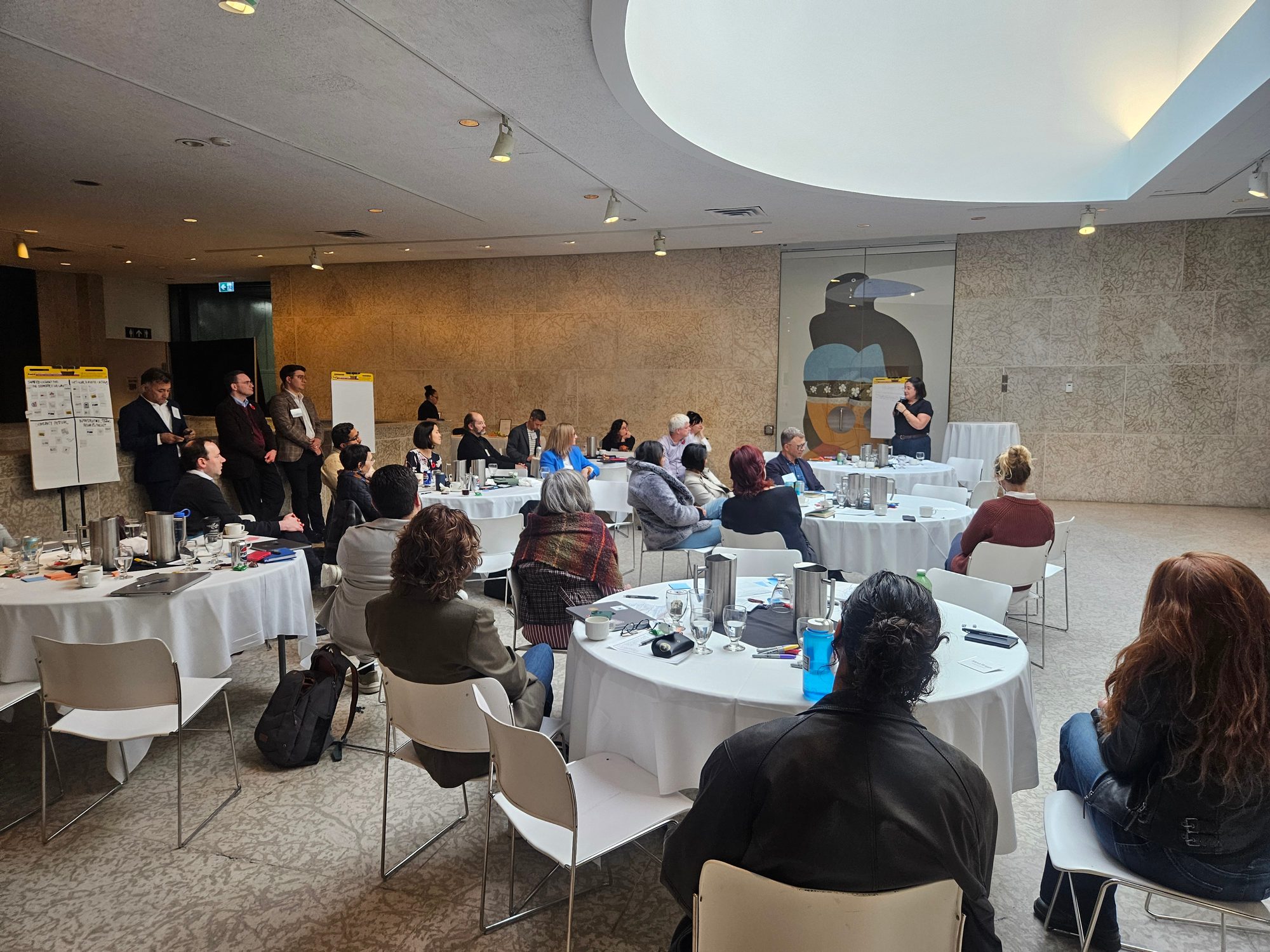
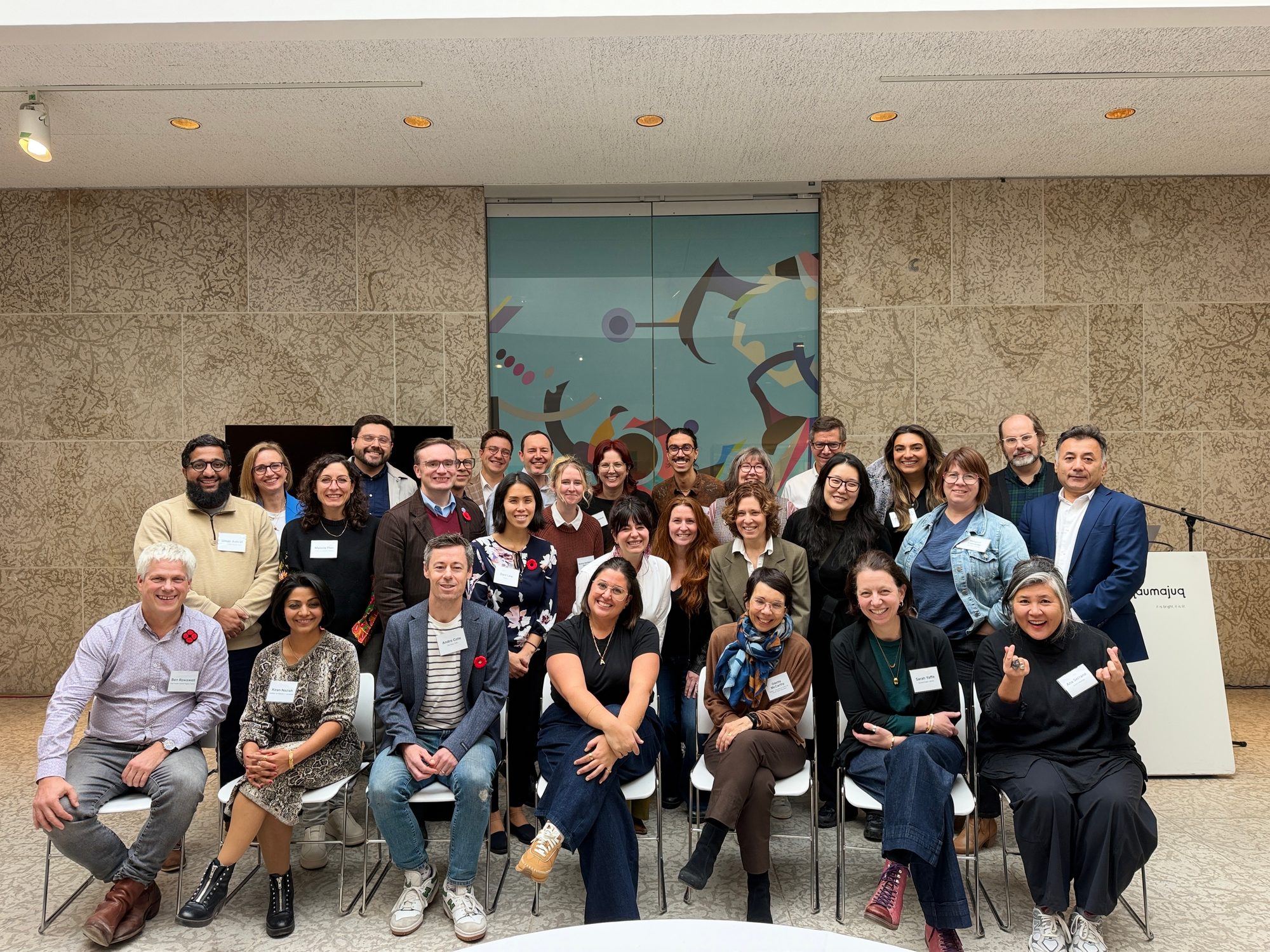
On Tuesday, November 10, 2026, people from democracy organizations across Canada met for a day at the Winnipeg Art Gallery-Qaumajuq. Thirty-two people were expected, from 29 organizations and two taking part as independents. The group photo taken after the close shows 29 people: one each from 27 organizations, and the two independents. They are listed at the end of this section. Twenty-eight of the 29 placed dots.
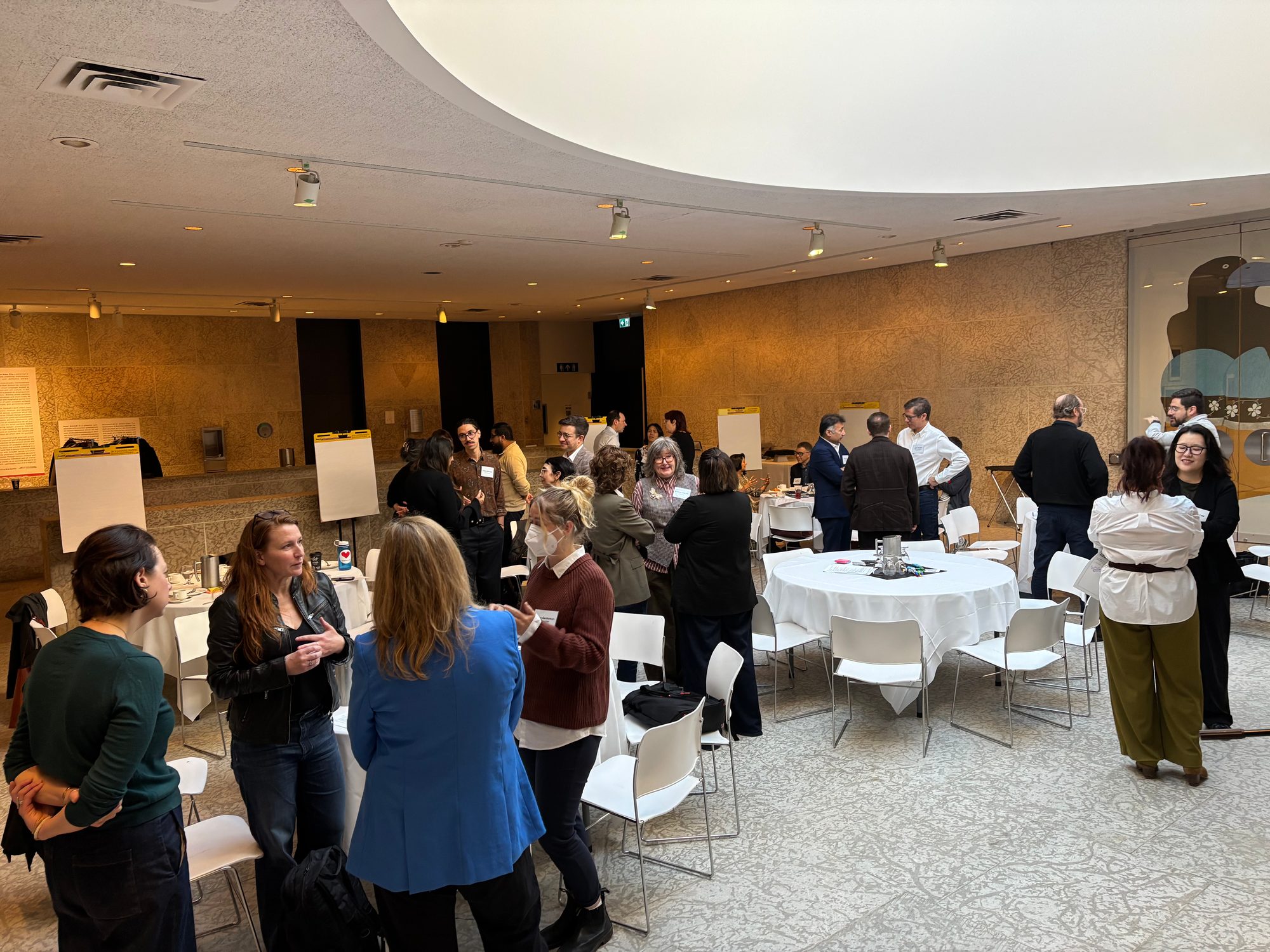
They heard four pitches from the working groups and two shorter ones added on the day. They sat at initiative tables twice. They looked at who is missing. Then they answered four questions about how to organize, one dot per organization, and put their logos on the initiatives they will join.
| Question | Decision | Count |
|---|---|---|
| 1. What do we call ourselves? | Canadian Democracy Network | 16 of 28 dots on the first placement |
| 2. Who belongs? | Organizations vote and individuals join as associates | 22 to 4 on the second placement, which reversed the first (18 to 10 for organizations only) |
| 3. Who holds the coordination function, the contact list and any money for the next year? | An independent incorporated body now | 19 to 7 on the second placement (18 to 10 on the first) |
| 4. Who carries this forward after November 10? | A transition team of the co-leads who want to continue, for up to two years | 27 dots, none for the other two options |
All 29 signed on to at least one of the nine initiatives, 87 sign-ons in all. The draft principles drew 22 notes.
This page is the record of the day: what was decided and how, and what was said. It is not a case for anything. It is built from photos of the walls and from recordings of the parts of the day when everyone was together. The table conversations were not recorded.
How to read it. Sections and paragraphs are numbered so you can point to one. Quotes are word for word from the recordings, and the speakers are not named.
Who is in the group photo
The 29 people in the group photo, by organization.
- Apathy is Boring: Sam Reusch
- Canadian Association of Journalists: Brent Jolly
- The Canadian Muslim Vote: Umair Ashraf
- CityHive: Rowan Gentleman-Sylvester
- Coalition for Women in Journalism: Kiran Nazish
- The Dais, Toronto Metropolitan University: André Côté
- Democratic Engagement Exchange, Toronto Metropolitan University: John Beebe
- Digital Public Square: Shlomit Broder
- Equitas: Odette McCarthy
- Fair Vote Canada: Chris Mohan
- Independent: Anna Miller
- Independent: Victoria Kuketz
- Institut du Nouveau Monde: Malorie Flon
- Investigative Journalism Foundation: Zane Schwartz
- MASS LBP: Chris Ellis
- MediaSmarts: Kathryn Ann Hill
- New Majority: Amanda Munday
- Nonprofit Chamber: Alexa Briggs
- OCAD University: Ana Serrano
- Paul Austin Human Rights Centre: Ben Rowswell
- Polity: John Richardson
- Resilient Societies: Maiwand Rahyab
- Section 1: Dani Law
- SFU Morris J. Wosk Centre for Dialogue: Robin Prest
- Strong Cities Network: Eunhye Lee
- Tamarack Institute: Jorge Garza
- Toronto Public Library: Sarah Yaffe
- Volunteer Canada: Megan Conway
- The Walrus: Jennifer Hollett
2 The agenda
-
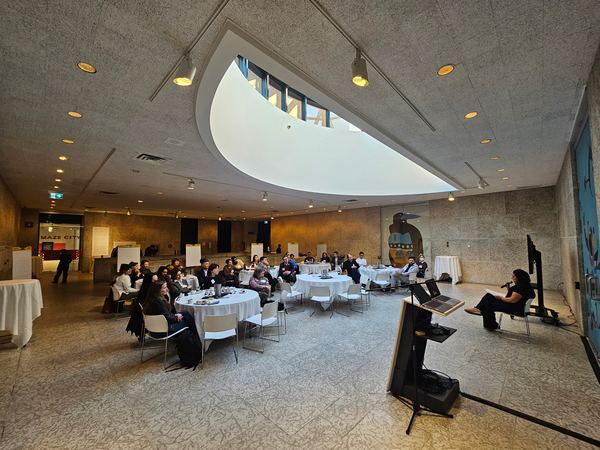 Opening
-
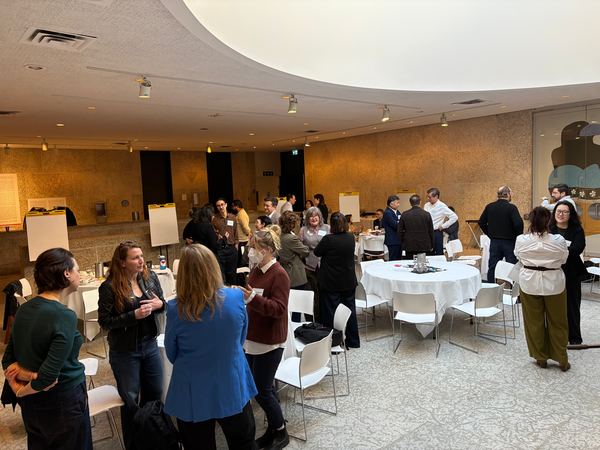 Speed introductions
-
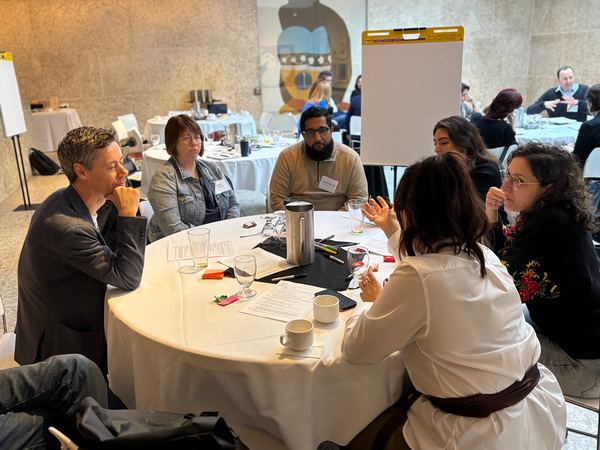 Initiative tables
-
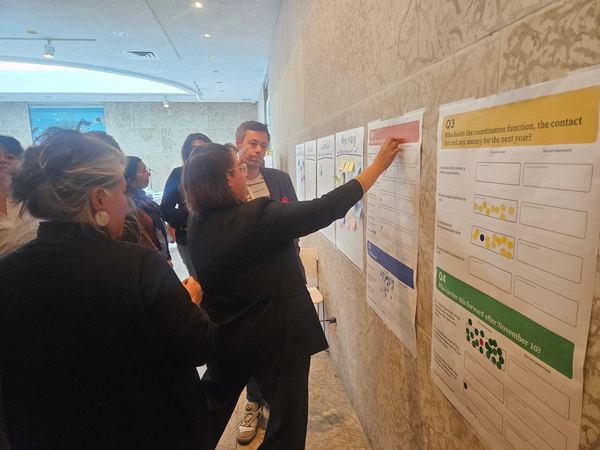 At the walls and the votes
-
 Closing
-
 The group photo
| Time | Session |
|---|---|
| 8:30 am | Breakfast and registration |
| 9:00 | Opening |
| 9:15 | Speed introductions, rounds 1 and 2 |
| 9:40 | Pitch 1: Civic education across the lifespan |
| 10:05 | Pitch 2: Democracy between elections |
| 10:30 | Break |
| 10:45 | Pitch 3: Public narrative campaign |
| 11:10 | Pitch 4: Public investment in democracy |
| 11:35 | Initiative tables, round 1 |
| 12:00 pm | Lunch |
| 1:00 | Speed introductions, round 3 |
| 1:15 | Who is not here |
| 1:45 | Initiative tables, round 2 |
| 2:15 | Break |
| 2:30 | How do we want to organize ourselves? |
| 3:30 | Signing on |
| 4:05 | Closing circle |
| 4:30 | Cocktail reception, then an informal dinner |
Two short pitches were added on the day, before the second round of initiative tables: electoral reform, and tech accountability and the information ecosystem.
3 The four decisions
-
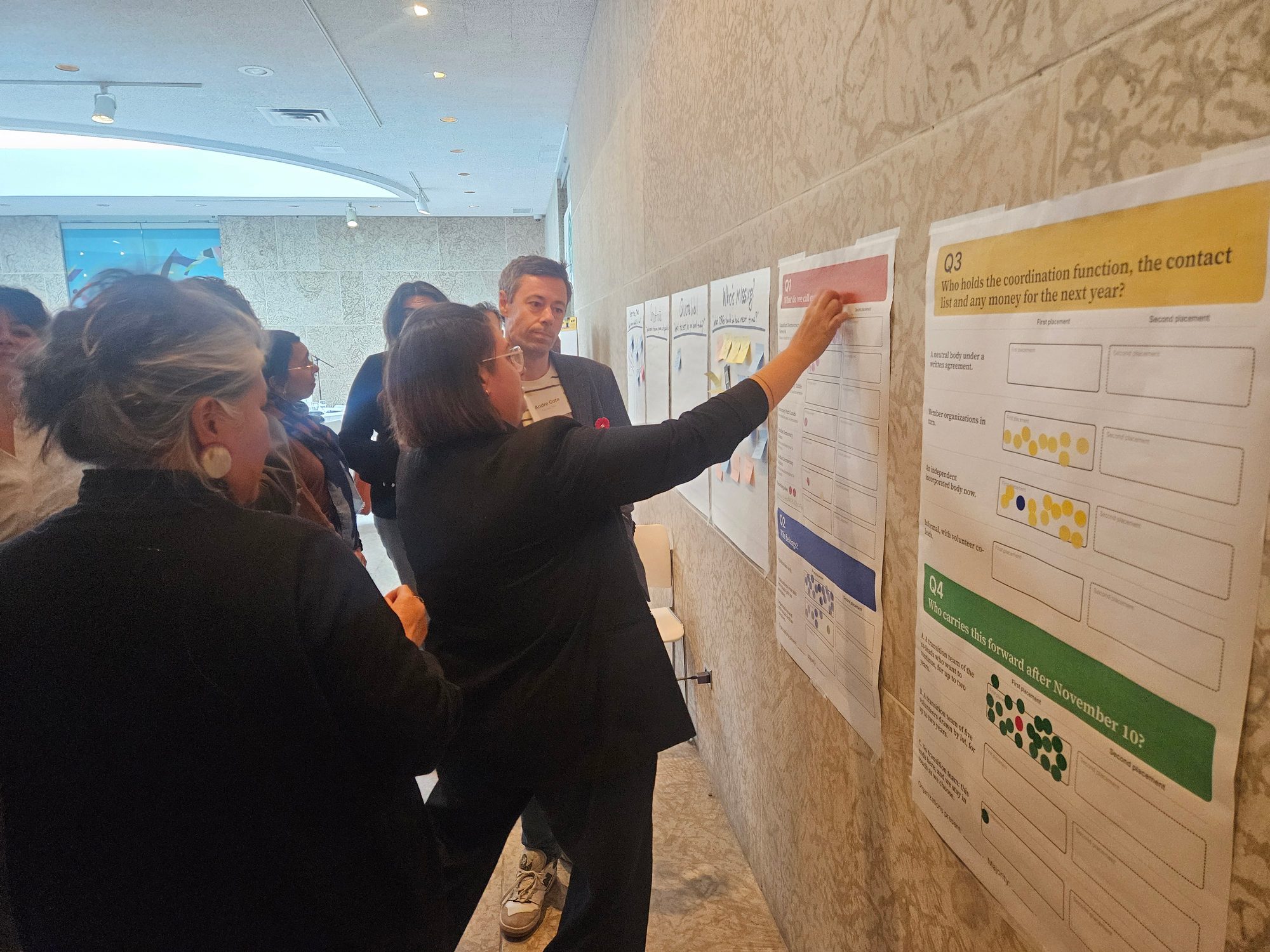
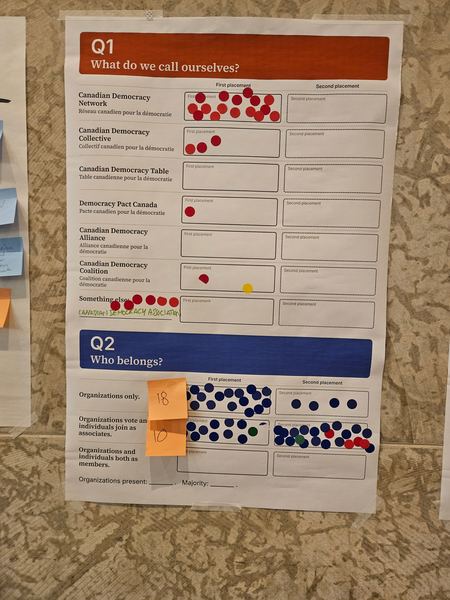 Question 1 and question 2, as the posters stood at the end of the day
-
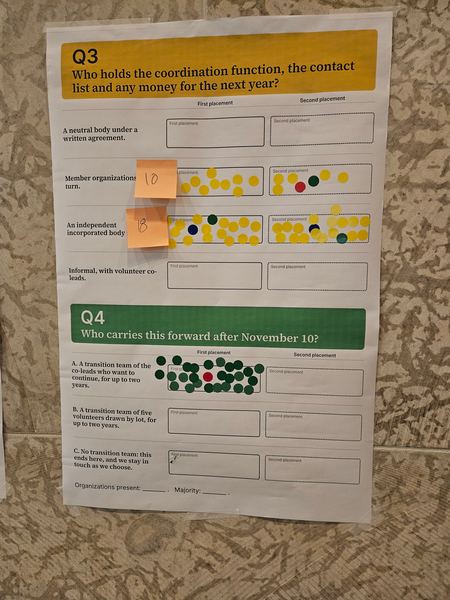 Question 3 and question 4, as the posters stood at the end of the day
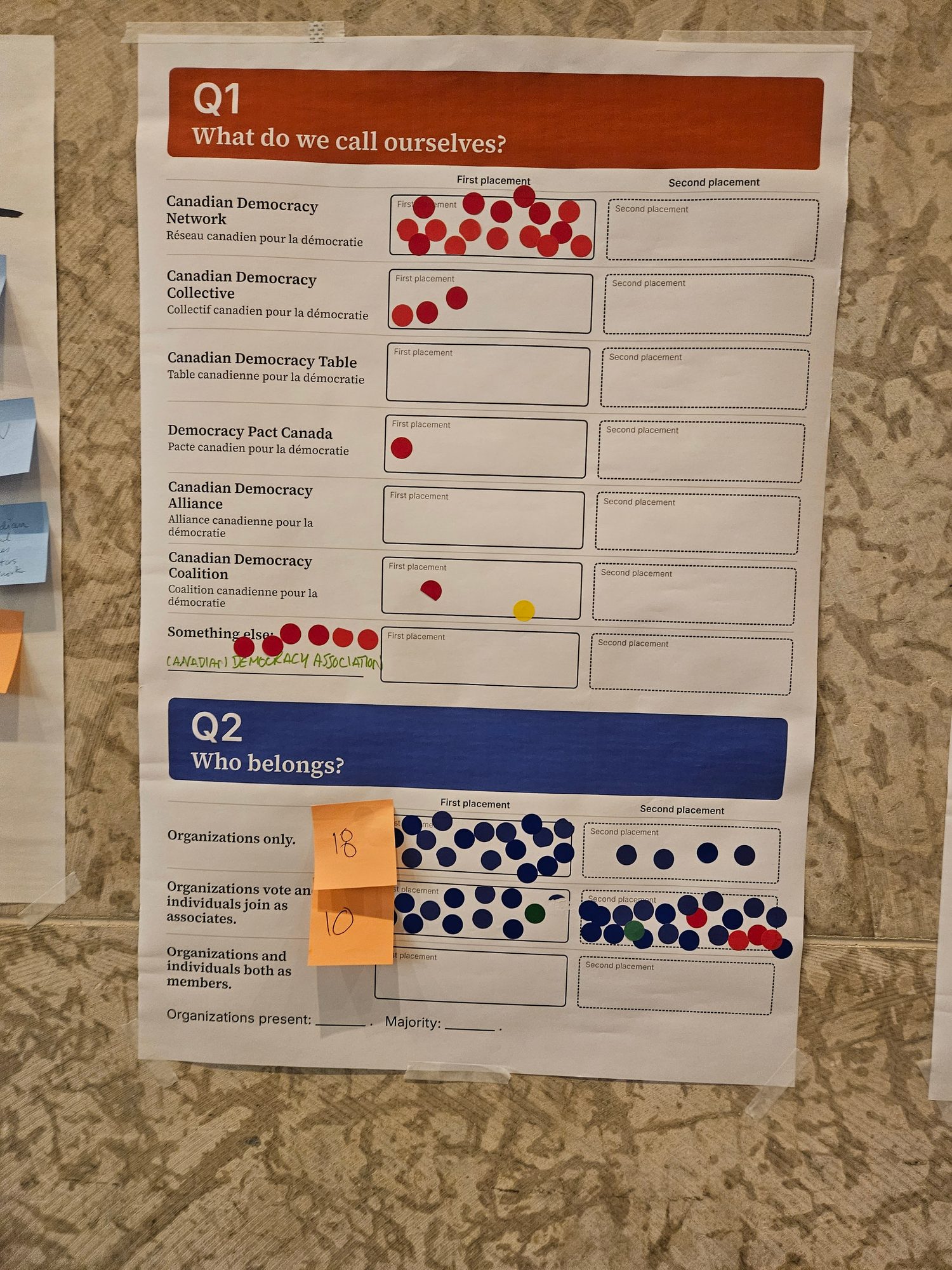
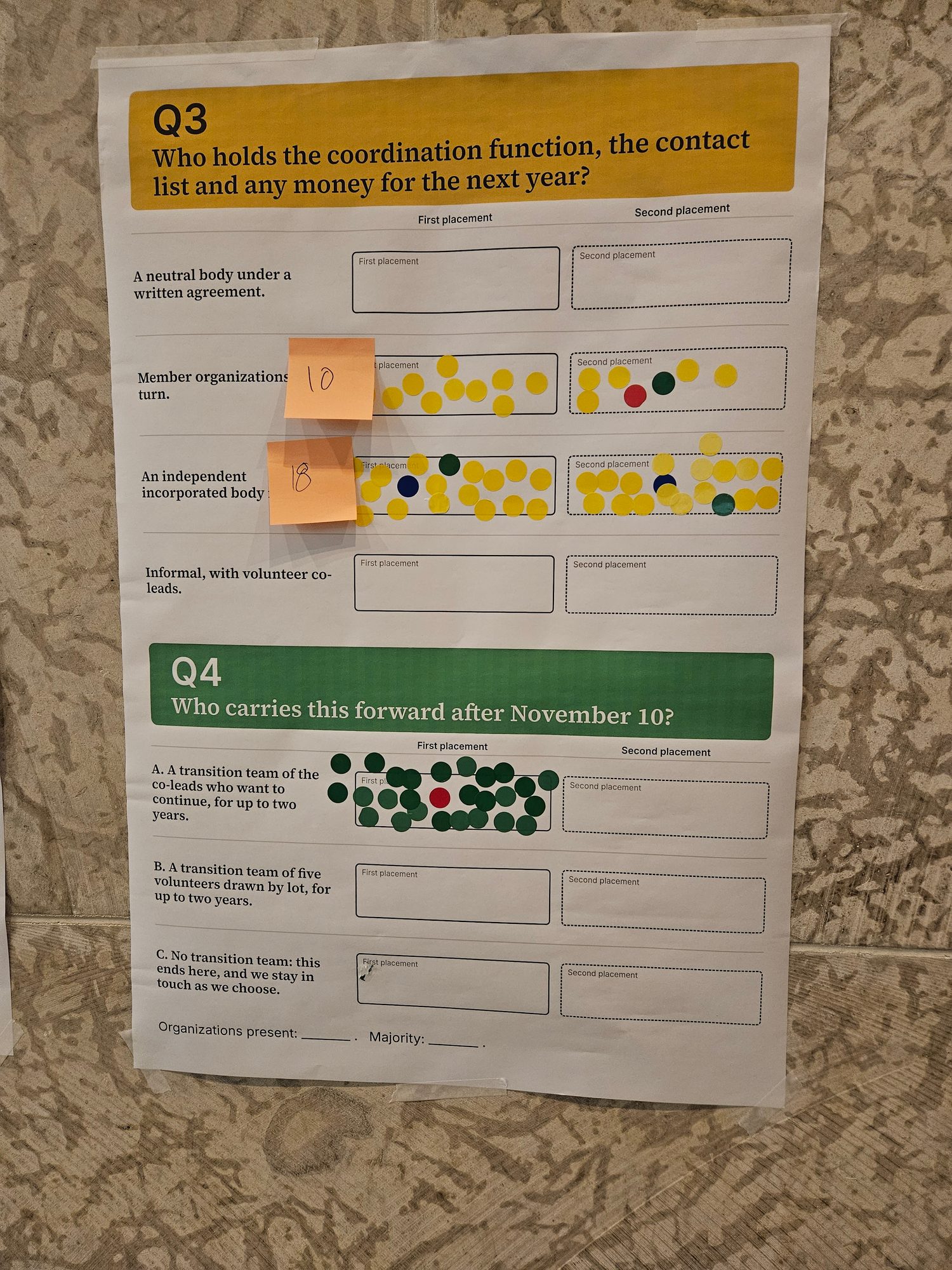
How the voting went
Each organization had one dot per question. The posters had two boxes beside every option, one for a first placement and one for a second. The rule, as the facilitator put it before the vote: "The left box is round one, and if there is no majority, then we do another second round."
Before any dots went up, the facilitator presented research on how 34 other networks and coalitions had organized themselves, went through the four questions, and took questions and comments for about 45 minutes. He then gave his own recommendations, based on what other networks have done: organizations only as members; hosted by a member organization or incorporated; and whoever has been helping carries on. On the name he said he did not think it mattered a great deal, as long as people were comfortable with the cautions noted on two of the options.
People placed their first dots on all four questions at once. The facilitator then announced a majority on all four: Canadian Democracy Network, organizations only, an independent incorporated body now, and a transition team of the co-leads who want to continue.
A participant then said there was clear consensus on questions 1 and 4 and asked to hear more on 2 and 3. The facilitator read out the counts and opened a discussion. After about 15 minutes he asked by show of hands whether to vote again on question 2, and then on question 3. Of the second he said the response seemed less enthusiastic. Both were voted again, in the second boxes.
The second placement stands. It reversed question 2 and confirmed question 3.
Okay, question two. Overwhelming majority: organizations vote and individuals join as associates. It's a flip. And question three. Independent incorporated body. It sustains.
The counts below are the dots on the posters as photographed at the end of the day, counted twice by counters who did not see each other's count. The two counts agree on every box.
Before the vote: is it too soon to decide?
Before any dots went up, several people said the questions were hard to answer on the day.
I think, like, before we can get to, you know, questions around the name, the governance, whether or not we can sign organizations up for it, we need to be, like, really crystal clear about, like, what is the purpose of this thing that we're building? What will it do and what will it not do?
The facilitator answered that a shared mission takes time and trust to build, and that the day had been built the other way round on purpose: start from the work people already want to do together, and let the structure follow.
What we could agree on was there can be specific initiatives that some organizations want to participate in, and if there's fruit coming out of that or results coming out of that, then, then there is some legitimacy and coming back together and doing more things.
It's not totally clear, like, where there will be ongoing funding, what is the governance structure for the network, what are the investment priorities, how will the thing be stewarded. Like, those seem like they're really important questions that I feel incapable of answering on the spot today.
When I hear the word transition and someone who's very new to this, I panic a little bit, because I don't know who has talked to the funder.
A participant who has helped lead the work answered that funders are forming a network of their own, and that the organizations could work with it together, with a strategy, or each alone.
So maybe the question is, like, how might we craft an interim structure that will allow different configurations of us to come and work together?
Like, we're never going to all agree on the same vision or priority or whatever as a group.
Question 1. What do we call ourselves?
Canadian Democracy Network. Decided on the first placement.
| Option | Dots |
|---|---|
| Canadian Democracy Network | 16 |
| Canadian Democracy Collective | 3 |
| Canadian Democracy Table | 0 |
| Democracy Pact Canada | 1 |
| Canadian Democracy Alliance | 0 |
| Canadian Democracy Coalition | 2 |
| Something else: "Canadian Democracy Association", written in | 6 |
When the question was presented, a distinction was drawn between a coalition and a network: a coalition usually forms around a campaign and can dissolve when it is done, while a network exists to keep people connected and can give rise to several coalitions.
The write-in came from the floor.
Just wondering if we looked at the word association at all.
It had not been looked at.
There's a tension, I think, between the name and membership. So a network, I can imagine being open, anyone could join, you just part of the network. If it's action-oriented, like a coalition, then you might want to have a bit more of a gating function.
Maybe we can return to this, but I did want to ask, like, why don't we look at forming an association?
One participant described a pact of organizations in Brazil.
They started as a group of 15 organizations, and they just agreed to try to work collaboratively together, and they picked a non-controversial issue to begin so that it was easy for people to agree to work together. And then now there are 200 people and they have a staff team.
I just looked at association. It's usually a common purpose and some shared objectives. I think the network may be a little bit more open.
Several people said they were unsure whether the group was a network, a coalition or an association, and what the difference would mean in practice.
So I hereby declare the creation of Canadian Democracy Network.
Question 2. Who belongs?
Organizations vote and individuals join as associates. Decided on the second placement, which reversed the first.
| Option | First placement | Second placement |
|---|---|---|
| Organizations only | 18 | 4 |
| Organizations vote and individuals join as associates | 10 | 22 |
| Organizations and individuals both as members | 0 | 0 |
Before the first vote, the question was put as a tension.
Around the theme of democracy, there's also this tension of this value of being really open and inclusive, where anybody can join. But then if anybody can join, it's no longer a space for organizations to broker partnerships, right?
If the group wants to involve more individual activists, a lot of indigenous organizations also don't have formal organizations per se.
I think to the question of membership and deciding who's a member, another, I think, upstream decision is what are the rights and responsibilities of members?
The first vote went to organizations only, 18 to 10. The facilitator then asked to hear the case for individuals. What changed minds was the discussion that followed.
I was interested in continuing to have the expertise of some people who may not be currently representing organizations still able to contribute to the wider activities of the group, but I appreciate maybe the distinction between voting member versus associate or something along those lines.
God forbid any one of our organizations in this room were to lose its biggest funder tomorrow and cease to exist. [...] I think that's actually the kind of brain drain this work cannot afford.
Another participant said a network they belong to had the same conversation some years ago and chose to admit individuals.
It's hard enough to get a First Nations individual involved with a group that's very predominantly non-indigenous. It's way, way harder to get an organization.
Two who had voted for organizations only then spoke.
Just as somebody voted for organizations only, I am hopeful that we're not exclusive, like in a sense that we find some way to engage other people.
I voted for organizations that have voting rights, and that should be the center of it, but there can be some role for individuals.
I think you can have both, um, but we have to be really clear on that and define that.
The second vote reversed the first, 22 to 4.
The only difference discussed between a member and an associate was the vote: a member organization votes, and an associate does not.
Question 3. Who holds the coordination function, the contact list and any money for the next year?
An independent incorporated body now. It led on the first placement and held on the second.
| Option | First placement | Second placement |
|---|---|---|
| A neutral body under a written agreement | 0 | 0 |
| Member organizations in turn | 10 | 7 |
| An independent incorporated body now | 18 | 19 |
| Informal, with volunteer co-leads | 0 | 0 |
This was the question people were most divided on. The reasons given on each side were practical ones.
Before the first vote, a third view was put, which was not one of the options on the poster: one organization that agrees not to make the work its own could hold it for a year, while the network raises the money to incorporate.
I'm actually quite okay with a single organization that's willing not to brand it and, you know, pretend that it's their own, to hold the checks administratively for a year while we get enough momentum funding in place to incorporate.
The facilitator said his research found that arrangement rare, because the hosted work tends to become the host's project.
There's value in it being separate from an organization so it doesn't have the perception. [...] I wouldn't advocate for me continuing to hold this and to receive the funds without some more formal governance and some kind of steering structure, decision-making power.
I do find it hard to even contemplate this question if we don't even know what we're asking money for.
The first vote went to an independent body, 18 to 10. The facilitator then asked for the case for member organizations taking turns.
Well, I feel like if we take turns, we can start right away.
We can think about this is how we're going to work in the next year or the next two years. It's not the permanent way that's going to move us forward in the next five or six.
I didn't think, um, establishing a board of directors and filing audited financial statements was a good use of anyone's time, and so the more nimble and agile the network could be, the better.
I just worry about the idea of rotating, because I think that there could be the chance of discontinuity through the rotation.
The other benefit of having rotation is that maybe one year it's hosted in Vancouver, the other year in Winnipeg, and then in Halifax, I don't know.
My biggest worry is we're creating something that, uh, eventually will end up just another organization like the rest of us here, and we'll be competing for space and resources.
Money ran through this part of the discussion. Those who have held the work so far said the money for the day went through one member organization because it has charitable status, and many funders give only to charities. They said that hosting had cost their own organizations' fundraising. Others said the same happens across philanthropy, and one suggested asking the funders to make clear that hosting should not count against the host.
I've lived the realities of that, and it hasn't been easy. I voted for an independent organization to get out of that as possible.
Incorporate a not-for-profit corporation, and then have a fiscal agent.
The second vote confirmed the first, 19 to 7.
The transition team is to incorporate the body. By when was not decided.
Question 4. Who carries this forward after November 10?
A transition team of the co-leads who want to continue, for up to two years. Decided on the first placement, with 27 dots. No dots were on the other two options.
The other options were a team of five volunteers drawn by lot, and no transition team at all. The facilitator said of the last that the initiatives could go on without a network, and that "it's not the end of the world if we do go with option C."
There are twelve co-leads across the four working groups.
My question is, who are the co-leads, and are they interested?
Why drawn by lots? What's, what's the theory there?
If we want it to be anyone who wants to volunteer for the transition team, then people would sign up and we would randomly choose five people, so it's not a popularity contest.
I saw a bunch of hands up, so it seems like there are people that are interested. But at minimum, I think I would like to continue to be involved to, like, transition out of this, and then see from there.
A co-lead suggested the co-leads could take the role in turns.
If there's three of us on that, it would be like four months each. I don't know. I'm just throwing something out there.
It may be wise to get the baby to a place of health and, like, flight, is all I'll say.
Who is on the transition team was left to the co-leads. They were given time to decide whether to volunteer, so that nobody had to commit on the spot in front of everyone. At the close it was put this way: among the co-leads, whoever wants to continue can continue, "but it's hard to sign up immediately right now, so we'll come back for that."
How many voted
Twenty-eight dots went up on each of the first three questions the first time, and 27 on question 4. Twenty-six went up on questions 2 and 3 the second time. Every result clears a majority: 16 of 28 for the name, 22 of 26 and 19 of 26 on the second placements, and 27 on question 4. In all, 29 took part: 27 organizations and two independents.
4 Signing on
-
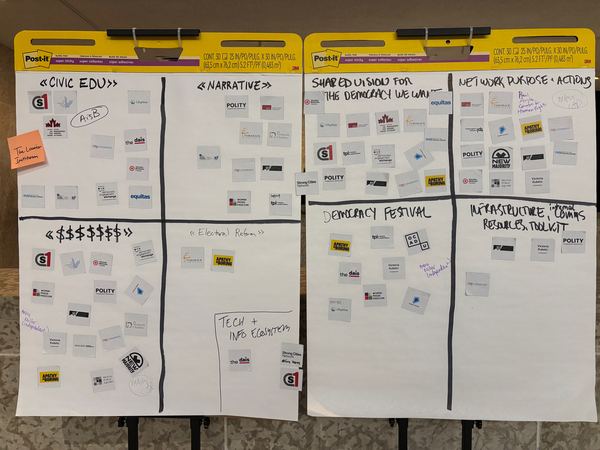 The two sign-on sheets, organizations under each initiative, as the posters stood at the end of the day
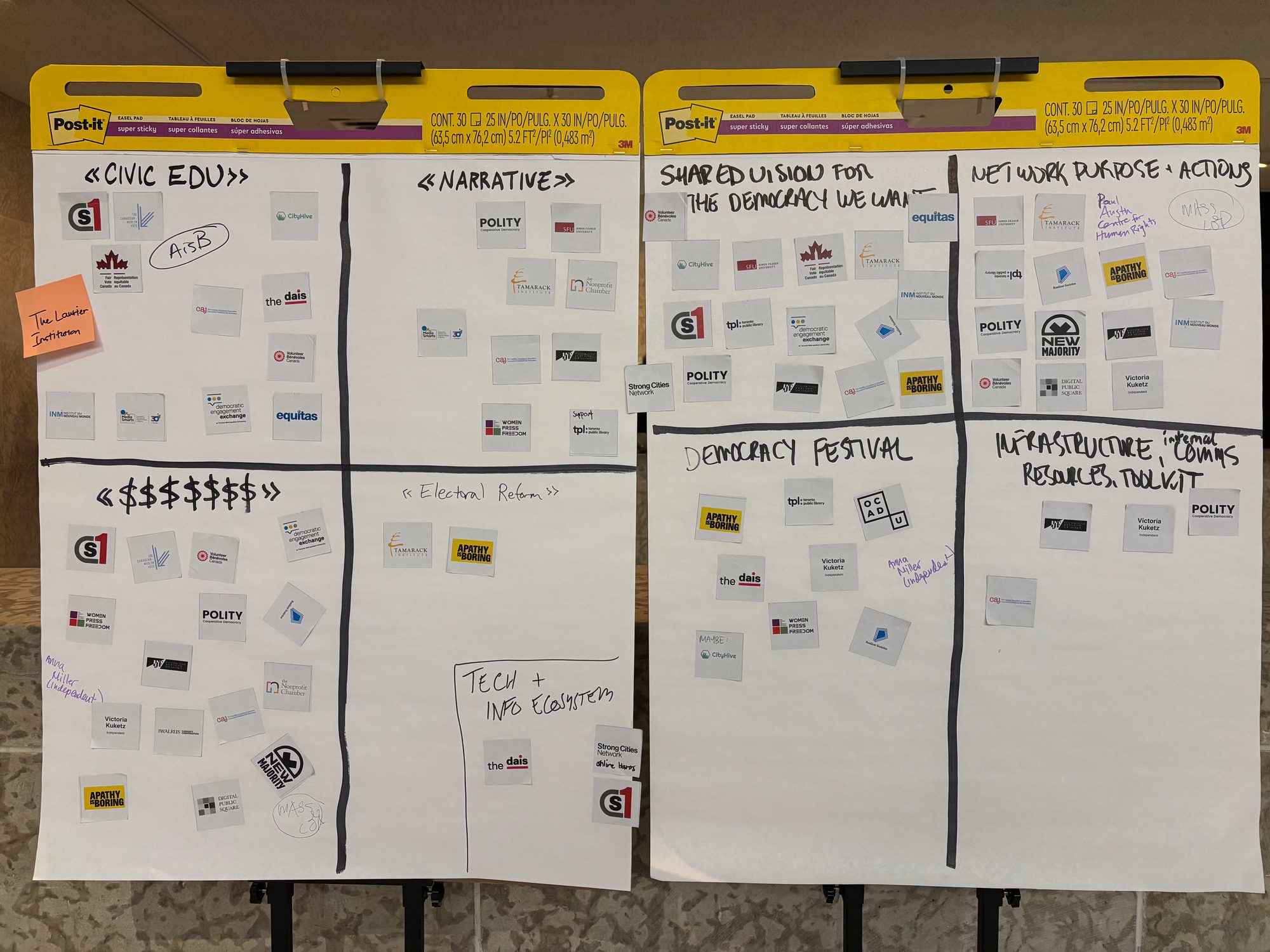
Signing on happened at the same time as the second vote. The facilitator's instruction: "if you can either put the sticker of your organization's logo or write down your organization for the initiatives, then we will consider that as the founding team of that initiative."
The initiatives were written as headings on two flipchart sheets. There were nine: one each for civic education, the narrative and public investment; four from the democracy between elections group; and the two added on the day.
| Initiative | Signed on |
|---|---|
| Public investment in democracy | 17 |
| A shared vision for the democracy we want | 16 |
| The network's purpose and actions | 15 |
| The civic learning pathway | 12 |
| A democracy festival | 9 |
| A public narrative about democracy | 9 |
| Shared infrastructure: internal communications, resources, a toolkit | 4 |
| Tech accountability and the information ecosystem | 3 |
| Electoral reform | 2 |
| Organization | Civic education | Shared vision | Network purpose | Democracy festival | Infrastructure and toolkit | Narrative | Public investment | Electoral reform | Tech and info |
|---|---|---|---|---|---|---|---|---|---|
| Anna Miller | ● | ● | |||||||
| Apathy is Boring | ● | ● | ● | ● | ● | ● | |||
| Canadian Association of Journalists | ● | ● | ● | ● | ● | ● | |||
| The Canadian Muslim Vote | ● | ● | |||||||
| CityHive | ● | ● | ● | ||||||
| Coalition for Women in Journalism | ● | ● | ● | ||||||
| The Dais, TMU | ● | ● | ● | ||||||
| Democratic Engagement Exchange, TMU | ● | ● | ● | ||||||
| Democratic Participation and Innovation Team, SFU Wosk Centre for Dialogue | ● | ● | ● | ||||||
| Digital Public Square | ● | ● | |||||||
| Equitas | ● | ● | |||||||
| Fair Vote Canada | ● | ● | |||||||
| Institut du Nouveau Monde | ● | ● | ● | ||||||
| Investigative Journalism Foundation | ● | ● | ● | ● | ● | ||||
| MASS LBP | ● | ● | |||||||
| MediaSmarts | ● | ● | |||||||
| New Majority | ● | ● | |||||||
| Nonprofit Chamber | ● | ● | |||||||
| OCAD University | ● | ||||||||
| Paul Austin Human Rights Centre | ● | ||||||||
| Polity | ● | ● | ● | ● | ● | ||||
| Resilient Societies | ● | ● | ● | ● | |||||
| Section 1 | ● | ● | ● | ● | |||||
| Strong Cities Network | ● | ● | |||||||
| Tamarack Institute | ● | ● | ● | ● | |||||
| Toronto Public Library | ● | ● | ● | ● | |||||
| Victoria Kuketz | ● | ● | ● | ● | |||||
| Volunteer Canada | ● | ● | ● | ● | |||||
| The Walrus | ● |
A dot means the organization or person signed on, with a logo sticker or a name written by hand.
The facilitator said: "We'll take photos, and the co-leads for each initiative will reach out to the ones who have signed up. And that is the initiatives that we'll carry forward."
Every organization in this table has agreed to be named publicly.
5 The draft principles
-
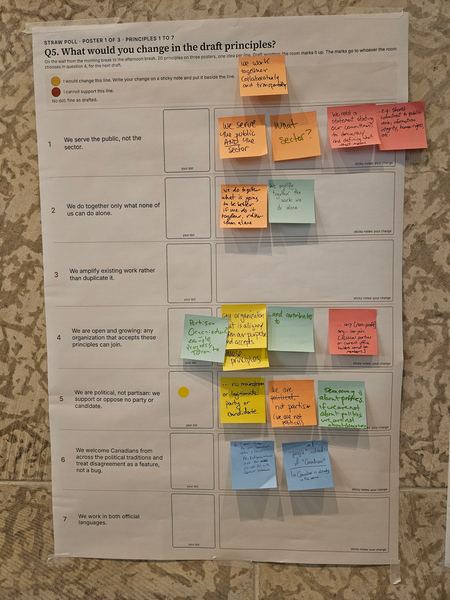 The draft principles, poster 1, principles 1 to 7, as the posters stood at the end of the day
-
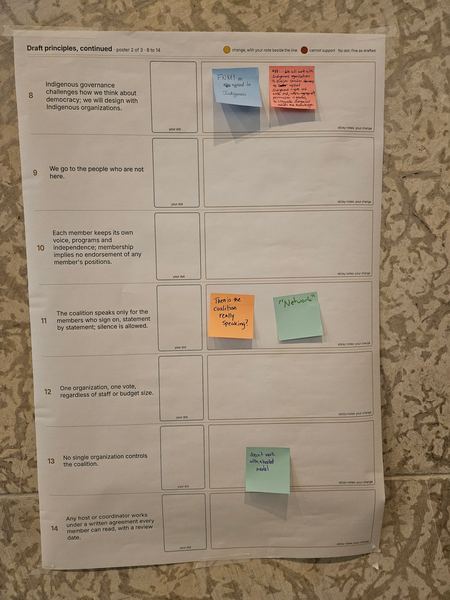 The draft principles, poster 2, principles 8 to 14, as the posters stood at the end of the day
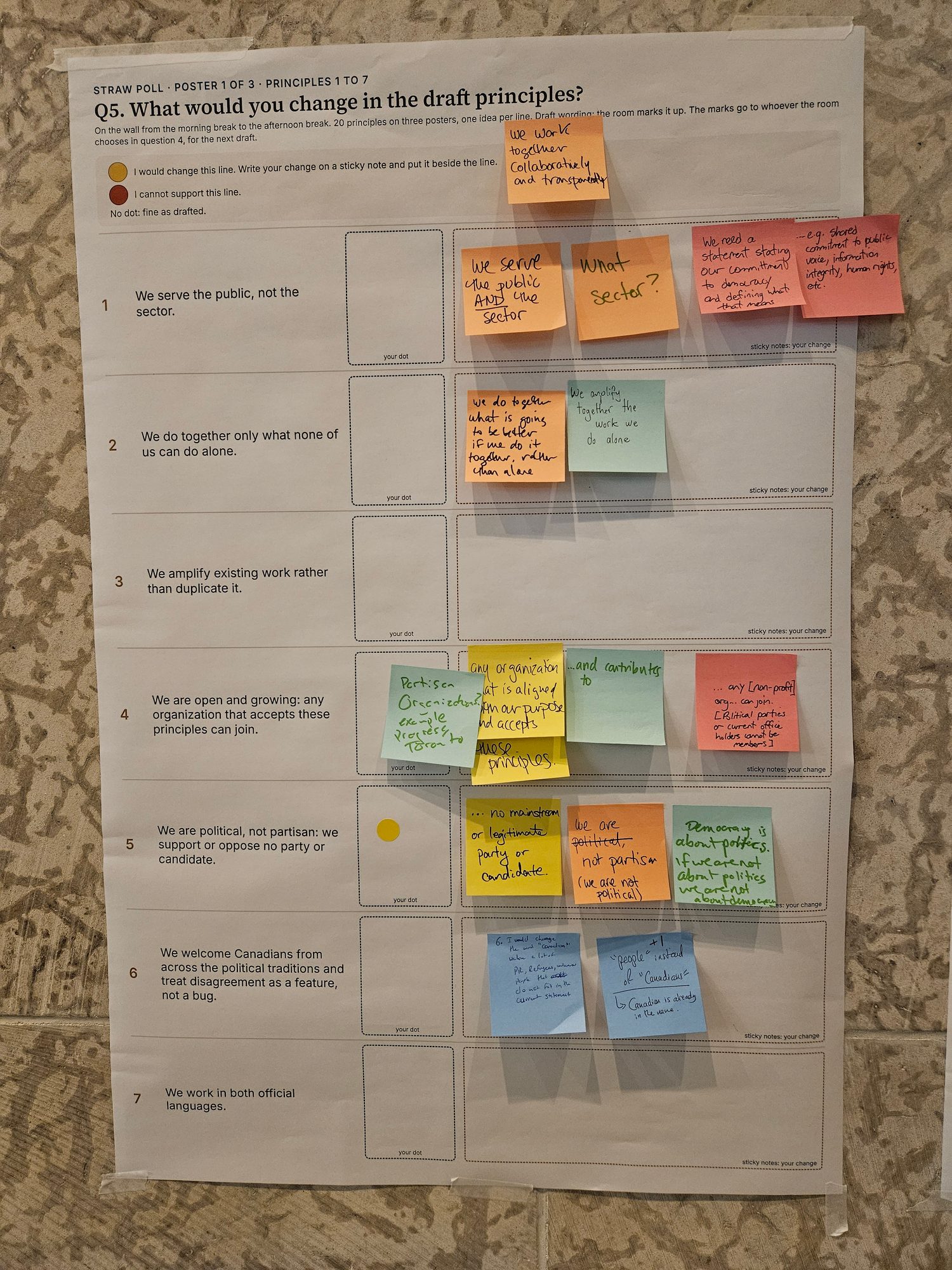
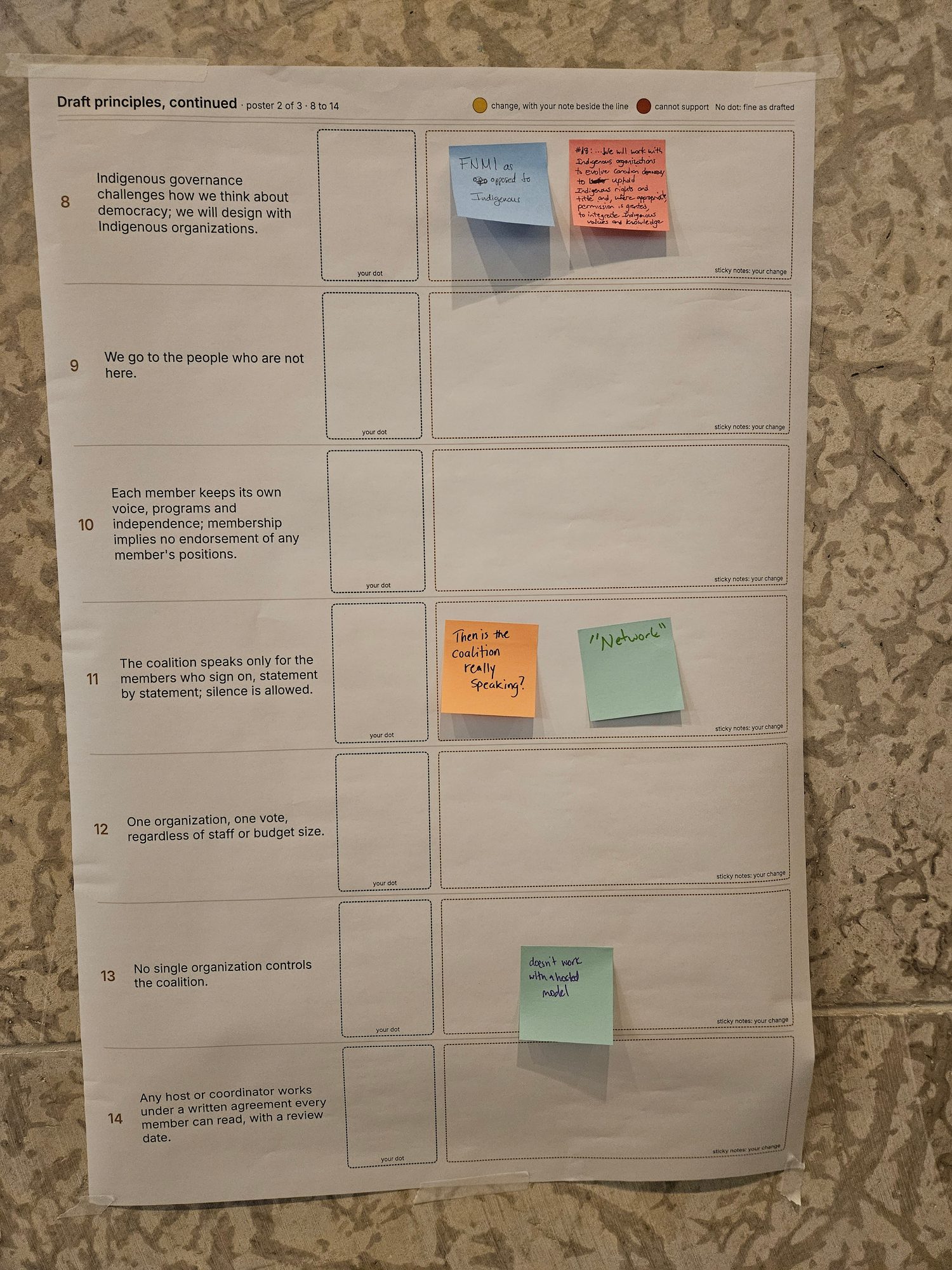
Twenty draft principles were printed on three posters for the wall. They were not voted on. The facilitator called it a straw poll on purpose, "because this is too much stuff for all of us to do here and reach consensus". People wrote the changes they wanted on sticky notes. The notes go to the transition team for the next draft.
The result: 22 sticky notes on the two posters that went up, which carried principles 1 to 14. The third poster, with principles 15 to 20, is in none of the photos of the wall and most likely did not go up.
| Draft principle | Notes on the wall |
|---|---|
| Above principle 1 | "we work together Collaboratively and transparently" |
| 1. We serve the public, not the sector. |
|
| 2. We do together only what none of us can do alone. |
|
| 3. We amplify existing work rather than duplicate it. | No mark |
| 4. We are open and growing: any organization that accepts these principles can join. |
|
| 5. We are political, not partisan: we support or oppose no party or candidate. |
|
| 6. We welcome Canadians from across the political traditions and treat disagreement as a feature, not a bug. |
|
| 7. We work in both official languages. | No mark |
| 8. Indigenous governance challenges how we think about democracy; we will design with Indigenous organizations. |
|
| 9. We go to the people who are not here. | No mark |
| 10. Each member keeps its own voice, programs and independence; membership implies no endorsement of any member's positions. | No mark |
| 11. The coalition speaks only for the members who sign on, statement by statement; silence is allowed. |
|
| 12. One organization, one vote, regardless of staff or budget size. | No mark |
| 13. No single organization controls the coalition. | "doesn't work with a hosted model" (written about 13 and 14 both) |
| 14. Any host or coordinator works under a written agreement every member can read, with a review date. | See 13 |
Read together, the notes cluster on three things. What "the sector" and "the public" mean in principle 1, which also came up aloud: one participant said it was hard to answer without knowing whether this is an association that serves its members or a network that serves the public. Who can join under principle 4, and whether partisan organizations can. And whether "political, not partisan" in principle 5 is the right way to say it.
6 What each group pitched, and the questions and comments that followed
Each working group had about 15 minutes to present and about 10 for questions. The slides are on the working groups page. What follows is what was said in the session, from the recordings. The table conversations that followed each pitch were not recorded.
Pitch 1. Civic education across the lifespan
Presented by the co-leads, Dani Law, Umair Ashraf and Odette McCarthy.
The proposal is a civic learning pathway: a shared framework for what Canadians should learn about democracy at each stage of life, starting with the school years. The co-leads said civic education in Canada varies a great deal between provinces and territories and has no shared framework. They were asked for a one-year initiative and chose to propose three years: a first year to map what exists and draft the pathway, a second to pilot it, and a third to revise it and add pilots. Beyond that they see professional development and accreditation for educators.
Provinces set the curriculums themselves. So this pathway would provide us with a common reference point, right?
The cost they gave is about $1.38 million over three years, with one paid position, a full-time pathway director, and about $150,000 for pilots in year two. They asked organizations to join a steering committee, and said plainly that it is a time commitment over three years. Each member would also take one of eight roles, from mapping the landscape and hosting consultations to francophone and Quebec partnerships, communications, and data and evaluation.
Questions and comments from participants:
- How will impact be measured, and what would a funder or partner be shown as success? The answers offered were teachers signing on and being accredited, classroom surveys, and pressing for civics to be part of provincial assessments, which one co-lead said are now mostly science and math.
- Is the civics teaching that already exists working? One participant said their generation had none, and asked what is going well now. The reply was that it is good that it is there, that in one province it is a half credit many students try to get out of the way, and that the real question is how to teach it so that it is engaging.
- Do not build something new where something can be adapted. Existing programs and partners were named, among them People for Education, which a second participant echoed.
- Take a broad view of civics: unions, service programs, schools that are more open to parents and the community, learning outside the classroom that earns a credit, and participatory budgeting in schools so that young people direct real money.
- Quebec already has a shared framework, built on a wide consultation, so the need there is different: more on participation outside the classroom. The pathway has to fit each province.
One thing I've struggled with is, like, how do you actually measure impacts in this space?
I would take a very broad definition of civics. To me, I would think about how do we engage, how do we support learners to think about how they can be engaged in everyday practices in building a healthy, resilient democracy.
Pitch 2. Democracy between elections
Presented by the co-leads, Sarah Yaffe, Victoria Kuketz and Robin Prest. The group gathered ideas from its members and voted on them. The two with the most support were a shared vision for democracy between elections, and shared infrastructure for the network.
They brought three areas for the first year, each with a step for now, for the next three to six months, and for the year.
- Imagining the democracy we want. A "workshop in a box" that any organization can take to the events it already holds, with visioning work already under way elsewhere brought in. After three to six months of that, bring the themes back and see what shared vision the group can support.
- Connecting and enabling the network. A shared drive and a way to talk to each other, starting this week and managed by the members themselves. Then agreed categories and standards. Within a year, a public, searchable collection of resources with someone looking after it.
- Clarifying the network's purpose and strategy. For now, a "good enough" set of principles to launch on. In the next months, whoever governs the network engages members on mission and vision. Within a year, a purpose statement written together.
So if there's groups who are already convening on democracy, this is a workshop in a box that could come out to your events that already exist. It's something that anybody could take to any space where they're already interacting with different communities.
For the second year and after: a democracy festival and a touring exhibit; gatherings in places the sector does not usually go, such as community halls, legions and libraries; an index of the health of democracy; help for organizations pitching and organizing policy advocacy together; and democracy sessions at other people's conferences. The group gave no budget: "We don't have a fancy budget."
Questions and comments from participants:
- The festival drew the most response. How is it different from DemocracyXChange, which already feels like one? Could democracy be brought into festivals that exist? Could it be many events across the country in the same week, hosted by different organizations, so that it is not in one place?
- Is this about changing institutions, or about more people taking part? Both, was the answer. One participant pressed the point that there are serious institutional problems and that groups like these should at least be seeding bolder ideas for fixing them.
- Involve elected officials and make the work visible to them.
- Do not create new outsiders. Migrant workers and people without status were named, and the reply was that the work needs deliberate outreach to those who are left out. Someone added that the word "democracy" itself puts some people off.
- Municipalities, and small organizations in small places that do this work without calling it democracy work, are missing from a national conversation like this one.
- Work with the civic education group, since the two overlap.
- One participant asked the group not to lose the first idea, the shared vision: "what feels interesting to me around this democracy between elections is actually developing that shared vision".
I just wonder whether groups like ours have to collectively at least be seeding some bolder ideas on how we fix the institutions, even if it's not necessarily the right moment to work with those institutions.
I'd love to understand more how do we build democracy in a way that it's leaving no one behind, especially those who have been ignored.
Pitch 3. Public narrative campaign
Presented by the co-leads, Kiran Nazish and Shlomit Broder. They opened by reading out the titles the group had tried and set aside, some dark, some hopeful, and ended on the one that stuck: let's make democracy cool.
The proposal has two phases. First, develop a public narrative about democracy: research on what Canadians think democracy is, then testing with different groups until a narrative holds. Second, run a public campaign to take it to Canadians, through media and through gatherings, person to person as well as by marketing. The narrative has to speak to people in a big-city downtown and in rural Alberta, to the Indigenous organizations the group hopes to bring in, and across the political spectrum. The co-leads called that the hard part: broad enough to include, without being watered down.
We're almost looking for a brand for democracy in Canada that will invite people in.
Inside the working group there had been a debate: is this a narrative about democracy, for Canadians, or about what the sector does? The group agreed on the first, and that what the sector does will follow. It had also debated whether to lead with the threat or with hope.
The plan, in the order given: research and a survey across Canada; eight to ten months to develop the narrative; then the campaign, which changes as feedback comes in; public engagement with universities, public institutions and elected officials; and amplification. About two years in all. No amount of money was said aloud; the figures are on the group's slides. The next steps are to form a core group, then settle the work plan and budget, then begin the research. The co-leads asked for people who care about narrative, with a hint to the journalists present, and for people who want to work on campaigns and gatherings.
So how do we talk about democracy? If you want to create a public narrative campaign, we need to understand what Canadians across Canada think about it.
Questions and comments from participants:
- "Cool" cannot be manufactured; it has to be allowed to emerge. The co-leads agreed that this cannot be a narrative a few organizations decide on and hand down. They suggested bringing in a professional firm, making the campaign participatory, with many voices in it, and telling the stories of the people who do the work of democracy.
- One participant proposed a hook: a public contest for the dumbest law in Canada, to get people laughing and then acting on something real. Another liked the idea and worried about what it would say about public institutions at a moment when trust in them is low.
- The platforms' algorithms favour anti-democratic messages without anyone trying, so what is "cool" online may not be what democracy needs. The co-leads answered that the same tools can be used for this work, that the limit is money, and that the task is to find narratives and messengers for which there is real demand.
- A narrative only holds if people see real change behind it. Without that it is a media campaign, or propaganda. The speaker asked how the narrative connects to the other work pitched that morning, and whether the people on the front lines would see a place for themselves in it. The co-leads agreed that a campaign needs a call to action, a step people can take, and said the difficulty is to say that democracy matters without implying that all is well.
The interesting thing about cool is that you can't bottle it, right? And so you need a way to kind of figure out, like, how to let it emerge as opposed to how to create a recipe for it because you can't make a recipe for it.
I think narratives will be promoted and will be accepted if, you know, if it's followed by or it promotes actual activities or actual change and it's based on real change that people see in their lives. So if narratives are not supported by those, it's more of like a media campaign or propaganda.
Pitch 4. Public investment in democracy
Presented by two of the co-leads, Anna Miller and Sam Reusch. The other two, Amanda Munday and John Beebe, hosted the group's tables. The pitch was titled "From advocates to architects: shaping how Canada funds democracy".
So this effort, this proposal, is a way forward to invite you as coalition members to become involved, to contribute, and so that we can be architects of this, not just advocates for the things that we know we need as a sector.
The starting point was a finding from the interviews: 40 of the 58 organizations said the way this work is funded is a problem. Democracy is a long process, and it is funded in projects of one to three years. Organizations spend their time chasing grants, and smaller ones are at a disadvantage. The co-leads' conclusion was that no single source of money will fix this. By "public investment" they mean both government and philanthropy.
Democracy is a process, but it's funded in one to three year projects.
They proposed three strands of work, each needing a small group of three to five.
- Working with the funders' network. A group of foundations has begun to share information among themselves. The proposal is to bring those funders and this network together at a summit in Ottawa in May, for a closed-door exercise built around a scenario such as interference in an election, so that members can show what each of them does and funders can think about their own part. What could follow is a small pilot with a few funders.
- The Canadian Democracy Fund. A proposal for a federal fund has been advanced with the government for a year and a half and has more than 180 endorsements. One co-lead said it is well advanced and could move within six months, and added, "we don't count our chickens". They asked organizations to endorse it, promote it, and take part in meetings with elected officials.
- Blended funding. Learn from funds in Canada and elsewhere that combine government and philanthropic money for networks like this one: interview ten or twelve of the people who built them, hold one or two round tables, ask what they got wrong, and then choose a direction and perhaps pilot a funding vehicle.
They also asked members to open doors to people the group should talk to, to join working sessions, and to share in confidence the risks their organizations face, so that an honest picture of the sector's position can be drawn.
Questions and comments from participants:
- What happens in five or ten years, when funders move on to the next thing? And is this the moment to hire a professional lobbying firm? The answer was that there is an unusual opening with the government now, that a campaign of that kind is not yet needed, and that it is not ruled out.
- What have environmental organizations learned from thirty years of working with donors, now that their funding is shrinking? The co-leads pointed to the scan of other funds they had posted and asked people to add to it.
- One participant raised three things. A network that both advocates to the federal government and asks it for money needs a way to do that ethically. Federal funding for the voluntary sector twenty years ago was cut when the government changed, so whatever is built has to be something every party sees as necessary. And is the group willing to approach conservative funders as well as progressive ones? No answer to these is on the recording.
- Participatory grantmaking: let the organizations that receive grants vote on the next round. The co-leads welcomed the idea and pointed to an example in their scan.
And so how do you inculcate whatever gets potentially funded for government in a way that all parties see it as something that is like a necessity to be successful?
I think the democratic revolution in philanthropy is around participatory grant making and spreading power to choose recipients in a kind of a democratic way.
Two more pitches, added on the day
Before the second round of tables, the facilitator introduced two additions.
Electoral reform. Fair Vote Canada, a mostly volunteer-run, member-funded movement organization, has been part of this process from the start. On the Friday before the session it was asked to bring a pitch on electoral reform. Instead of a pitch for a joint project, it made three invitations to the others: to learning and dialogue about electoral reform, to support, including presentations to boards, and to collaboration.
I kind of went back to the question, what can we do together that we can't do alone, and that kind of being the core founding idea of this group.
If your organization is focusing on democracy, the way we elect representatives is really upstream and structural intervention that can help with other issues.
Tech accountability and the information ecosystem. This topic, its presenter said, had come just below the threshold for a working group of its own. A separate coalition on it already exists and is active. The presenter described what that coalition does, sharing information and coordinating, said some of its members were not there on the day, and pointed to a bill on social media safety, introduced in June, as the main place for action.
We're calling it today tech accountability, but it's somewhere at the intersection of tech accountability, social media regulation, the information ecosystem.
The initiative tables
There were two rounds of tables, before lunch and in the afternoon. For the first there were six tables: civic education, the narrative and public investment at the front, and three for democracy between elections at the back, with the co-leads writing each table's initiative on a sheet. At least one co-lead hosted each table, and the facilitator asked the other co-leads to visit other initiatives on behalf of their own organizations. People were asked to go to a different initiative in the second round, which also had tables for electoral reform and for tech and the information ecosystem.
These conversations were not recorded, and there are no notes from the tables. One flipchart was photographed, from the public investment table. It carries the table's questions: how to advance the three pillars of government, philanthropy and blended funding; how to work with the funders' network, and with what structures and boundaries; and what would make this joinable for an organization.
What the slides add
This section keeps to what was said aloud. The short report describes each of the nine initiatives a little more fully, and the added detail is from the groups' slides, which are on the working groups page. What the slides add to the account above:
- The civic learning pathway. The pathway is described as a non-partisan framework from the early years into adulthood. Year two publishes a first version and tests it in two or three settings. Year three releases a second version, starts new pilots and adds a professional development module for educators. A steering committee of member organizations oversees the work with the pathway director.
- A shared vision for the democracy we want. What was called a "workshop in a box" aloud is a "dialogue in a box" on the slide: agreed questions, packaged so that anyone can host a conversation and send in what they hear. Within a year the themes come back to the network and a first version of the vision is published for feedback.
- The network's purpose and actions. Within a year, a purpose statement written with members, and a draft strategy brought to them.
- Shared infrastructure. In three to six months, agreed categories, accessibility standards and a simple searchable directory. The public collection aimed for within a year is named the Everyday Democracy Toolkit.
- A democracy festival. Named as Canada's first democracy festival, a launch and a celebration, for the second year and after. No date or budget is given.
- A public narrative about democracy. Research and listening begin in January. The slides estimate research and narrative development at $250,000 over eight to ten months, and the public campaign at $1 million over 18 months.
- Public investment in democracy. The funders' network is Democracy Funders Canada. Within twelve months the aim is three to five funders piloting multi-year core funding, and a first blended funding vehicle. Each strand asks for three to five more members, at about six to eight hours a month.
- Electoral reform and tech accountability were presented aloud and have no slides.
7 Who is not here
-
 Who's missing, as the posters stood at the end of the day
After lunch the session turned to who was missing. Each table took a sheet naming one group that was absent or thinly present: Indigenous organizations; conservatives; francophone Canada; the Prairies, the North and Atlantic Canada; and frontline communities. The question on each sheet was what would have to be different about this group for those people to see it as worth their time.
Only the end of the opening discussion was recorded. In it, one participant said the organizations take no side on policy issues outside democracy itself, and that the two should not be run together. Another offered to nominate organizations from the Maritimes that fit, and suggested that members ask each other who they already work with and bring them in, by video if need be. That participant also asked how others felt about being seen as a progressive coalition when most of the organizations do non-partisan work, said they would not be comfortable with that label, and said that if people do not feel comfortable coming into this space, the group has a duty to go into theirs.
What the tables reported
Five tables are heard reporting back; the recording starts partway through the first. Most had spoken about conservatives and Indigenous organizations and said so.
- The conversation itself was uncomfortable. One table named it: a conversation about people who are not present, by people making assumptions about them.
- The words are a problem. A table that included registered charities said that "conservative" and "progressive" are uncomfortable words for organizations with a duty to be non-partisan, and looked for another way to name the tension, such as power that is centralized against power that is spread out.
- Say what "democracy" means. More than one table came to this. A shared vocabulary would let people see whether the invitation is for them.
- Relationships come first, and take time. With Indigenous organizations: build the relationship with no request attached, stay in conversation, and start by supporting work they already lead. Invite a group of organizations together, not one at a time.
- For conservatives: a purpose statement that plainly includes conservative views, clear principles, and a willingness to work with people the members disagree with. Go to their conferences. Invite right-of-centre non-profits through the funders who already support them. Build links with civil liberties groups.
- People or organizations? One table asked whether the people who came did so because of a person or because of an organization, and what happens to the relationship when that person moves on.
- Money matters. For frontline communities the answer to an invitation may be yes at once if there is funding to take part.
We also really need to take the time to build relationships without any associated ask, and to stay in dialogue.
Are people coming in this room because the people have the relationship or the organizations have the relationship?
And for frontline communities, it might be immediate yes if there's funding.
It's an about us without us conversation.
Defining what we mean when we're talking about democracy will make the invitation so much clearer to people who may or may not see themselves in this room.
What the tables wrote
Fourteen idea sheets were left on the tables: five on Indigenous organizations, five on conservatives, two on the Prairies, the North and Atlantic Canada, one on francophone Canada and one on frontline communities. The ideas, as written:
Indigenous organizations
- Once we have clearer purpose + governance, easier to solicit participation.
- we need to take the time to build relationships without any associated ask. Stay in dialogue.
- Maybe we start by seeing how we support their work, as a first step.
- Explore new/old modes of democracies that reflect Indigenous tradition
- Avoid over-indexing on the system as a focus
- Something to be explored around "imagining our democracy"
- Trust + relationship
- Intentional listening (not performative)
- Safety.
- Engage Indigenous reps previously involved to get their views
- Building relationships over time
- dedicated funding for participating in this group
- invite a group of Cohort of indigenous organizations
- the fund should have reserved funding within the democracy fund for communities
- Shared vocabulary of what we mean by democracy
Conservatives
- Purpose statement includes language that demonstrates explicitly being inclusive of conservative ideologies.
- Attend and connect with people at conservative events (Canada Strong and Free & Manning Conference).
- Invite right-wing non-profits, as identified by conservative funders (Rossy, Donner, Hunter Foundations) to this network's events.
- Build more connections with civil liberties organizations.
- Clarity on our principles and be willing to work with people we disagree with.
- Learn from groups like D-Hub who bring diverse ideologies together.
- Clarify what we mean by "democracy"
- Spectrum of democracy: centralization, decentralization
- Do we understand why they don't want to participate?
- "Othering conversation"
- Agreement/discussion on definition of democracy. Shared vocabulary
- Common goals
- there is a perception on the right that progressives are too ideological / cause-driven, too activist, veering away from a more narrow definition of liberal / constitutional democracy.
- Building (and highlighting) relationships before an invite
- Supporting interface service & dialogue
The Prairies, the North and Atlantic Canada
- Using connections to vouch for the work, group.
- rural focus
- traditional Knowledge systems
- address historic regional differences
- shared & accessible language & vocabulary
Francophone Canada
- Cultural connections (there is no "one" Francophone community)
- Solidarity economy
The sheets were headed "Conservative democrats". On one, the word "democrats" is struck through by hand, and on another "Conservative" is circled. People found the term confusing, so this record says "conservatives".
Who should be here next time
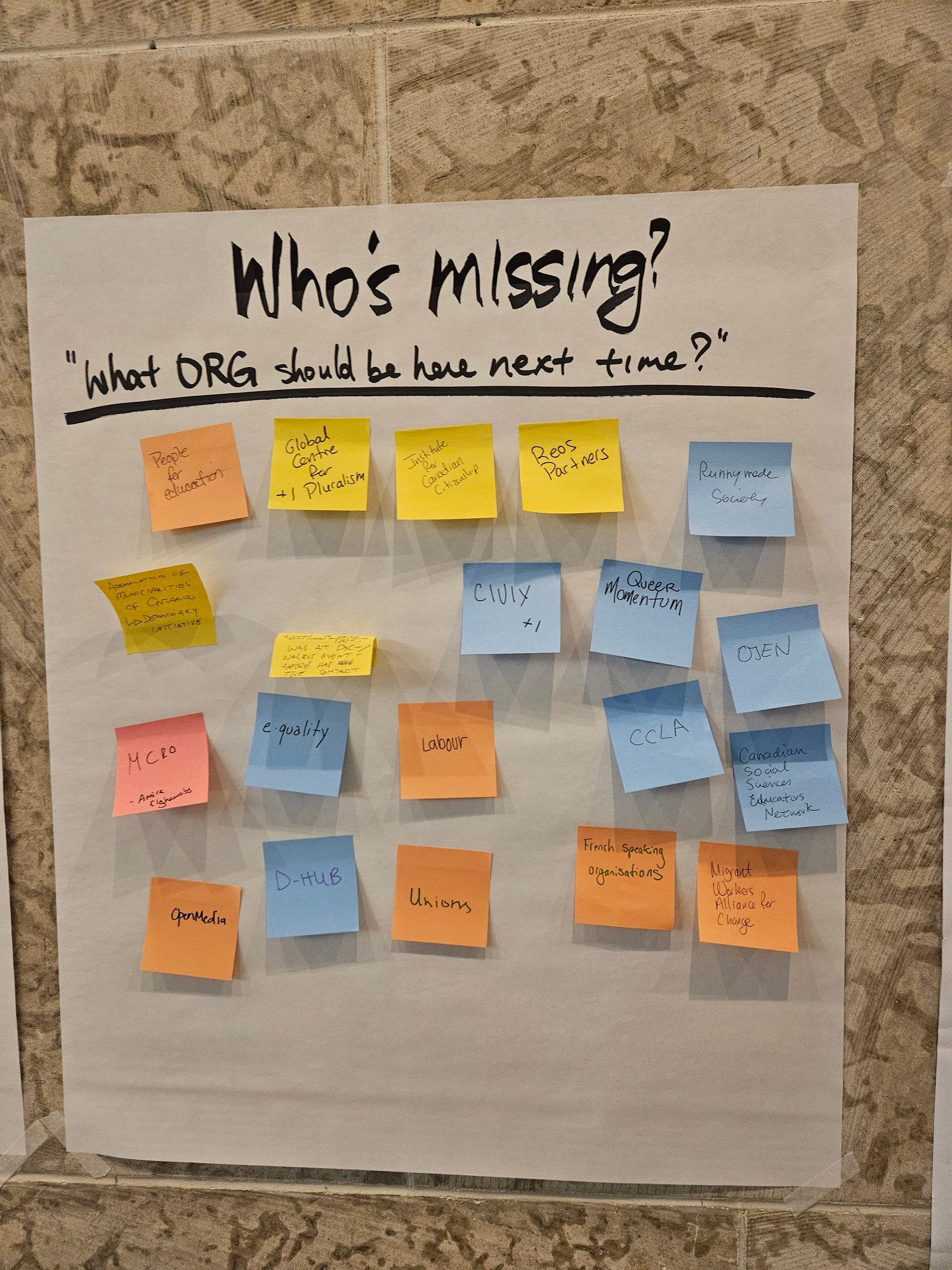
A sheet on the wall asked "What ORG should be here next time?" It had twenty notes by the end of the day. These are suggestions written by participants. Nobody has approached these organizations on the network's behalf. Each is listed here under the organization's full name, with a link to its website where it has one.
- Canadian Civil Liberties Association
- CIVIX
- D-Hub
- Equality Fund
- Fish Flight Entertainment
- Global Centre for Pluralism
- Healthy Democracy Project, Association of Municipalities of Ontario
- Institute for Canadian Citizenship
- Migrant Workers Alliance for Change
- Muslim Communities Research Observatory
- Ontario Justice Education Network
- OpenMedia
- People for Education
- Queer Momentum
- Reos Partners
- Runnymede Society
- Social Studies Educators Network of Canada
- Labour
- Unions
- French-speaking organizations
The question of who is missing came up all day, not only in this hour. In the morning a participant said municipalities and small rural organizations are often missing from conversations like this. In the vote on membership, the difficulty of bringing in First Nations organizations changed the result. And at the close the facilitator said: "We know there's people that weren't here; we will continue to bring them into this group."
A note from the facilitator on the caution
One table called this hour "an about us without us conversation". That is true of the hour. It is also true that some of these groups have already given their time. Three Indigenous-led organizations and two conservative voices were among the 58 heard in the listening that led to the network, and the April report records what they said: Finding 10 and Finding 4, sections 5.1 and 5.2 of the strategy, and the quote bank under Indigenous governance and conservative inclusion. With them, the next step is not another round of listening. It is to act on what they said, tell them what has been done, and build the relationship from there. Going back to listen again, with nothing done in between, takes their time and gives nothing back.
The same report says that francophone Canada, the Prairies, the North and Atlantic Canada, and frontline communities were barely heard in that listening: one francophone organization, almost no one from Alberta or Saskatchewan, and no frontline community voice (Finding 7). For them the caution holds in full.
8 The walls
-
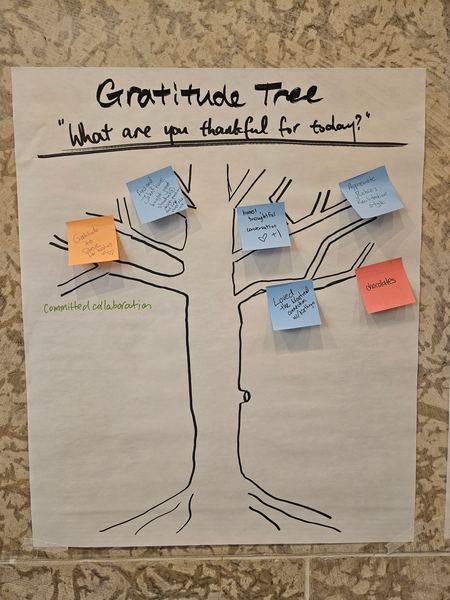 The gratitude tree, as the posters stood at the end of the day
-
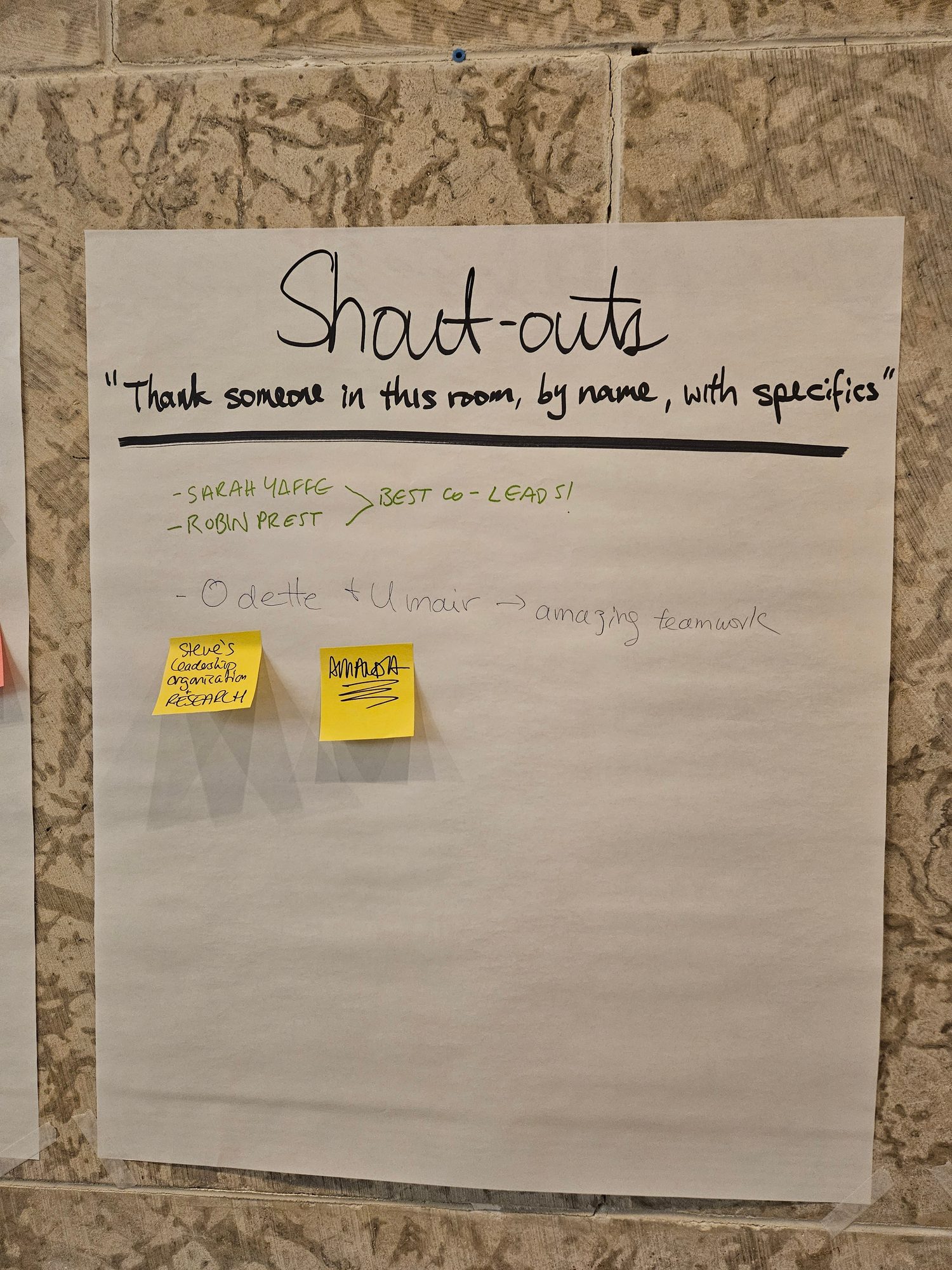
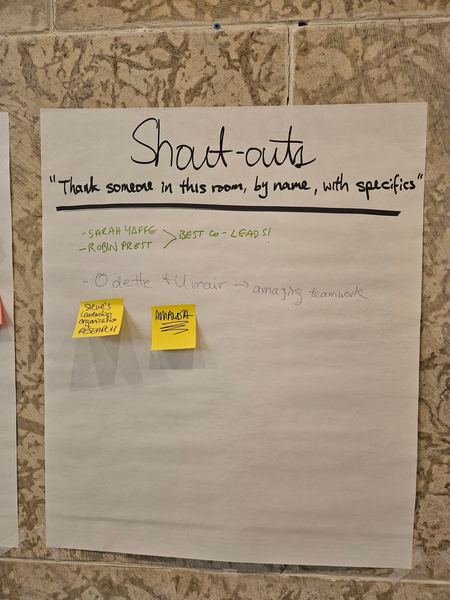 Shout-outs, as the posters stood at the end of the day
-
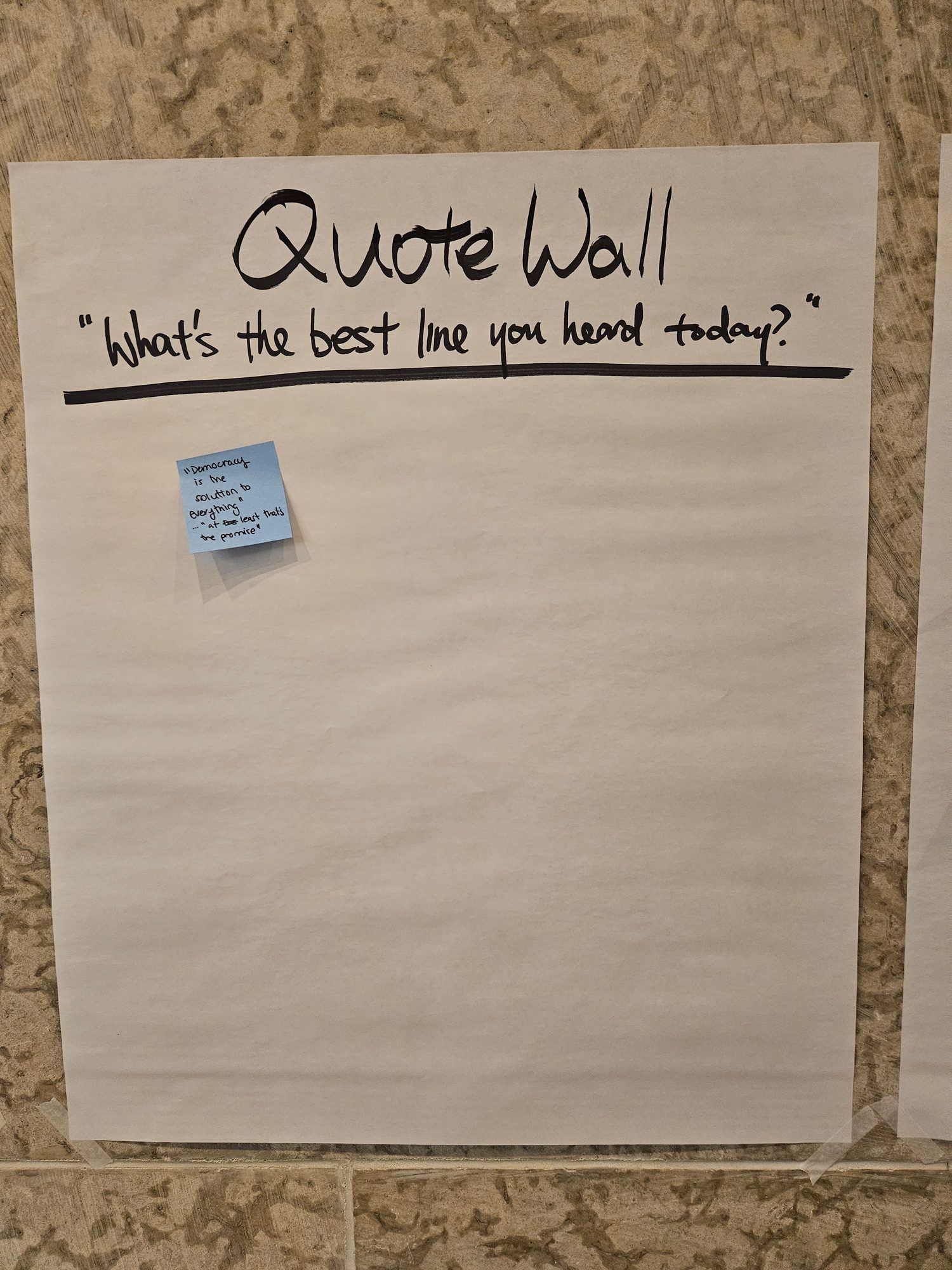
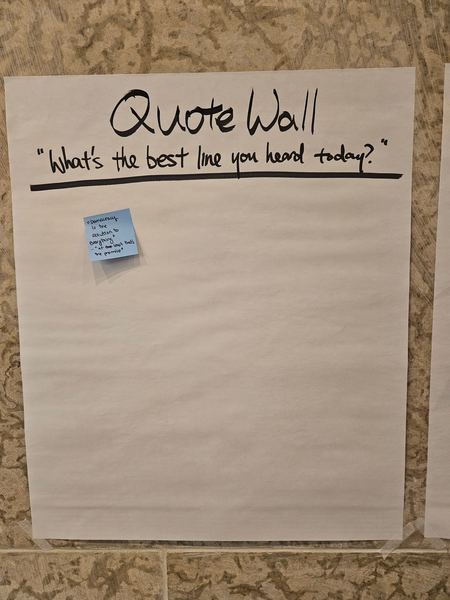 The quote wall, as the posters stood at the end of the day
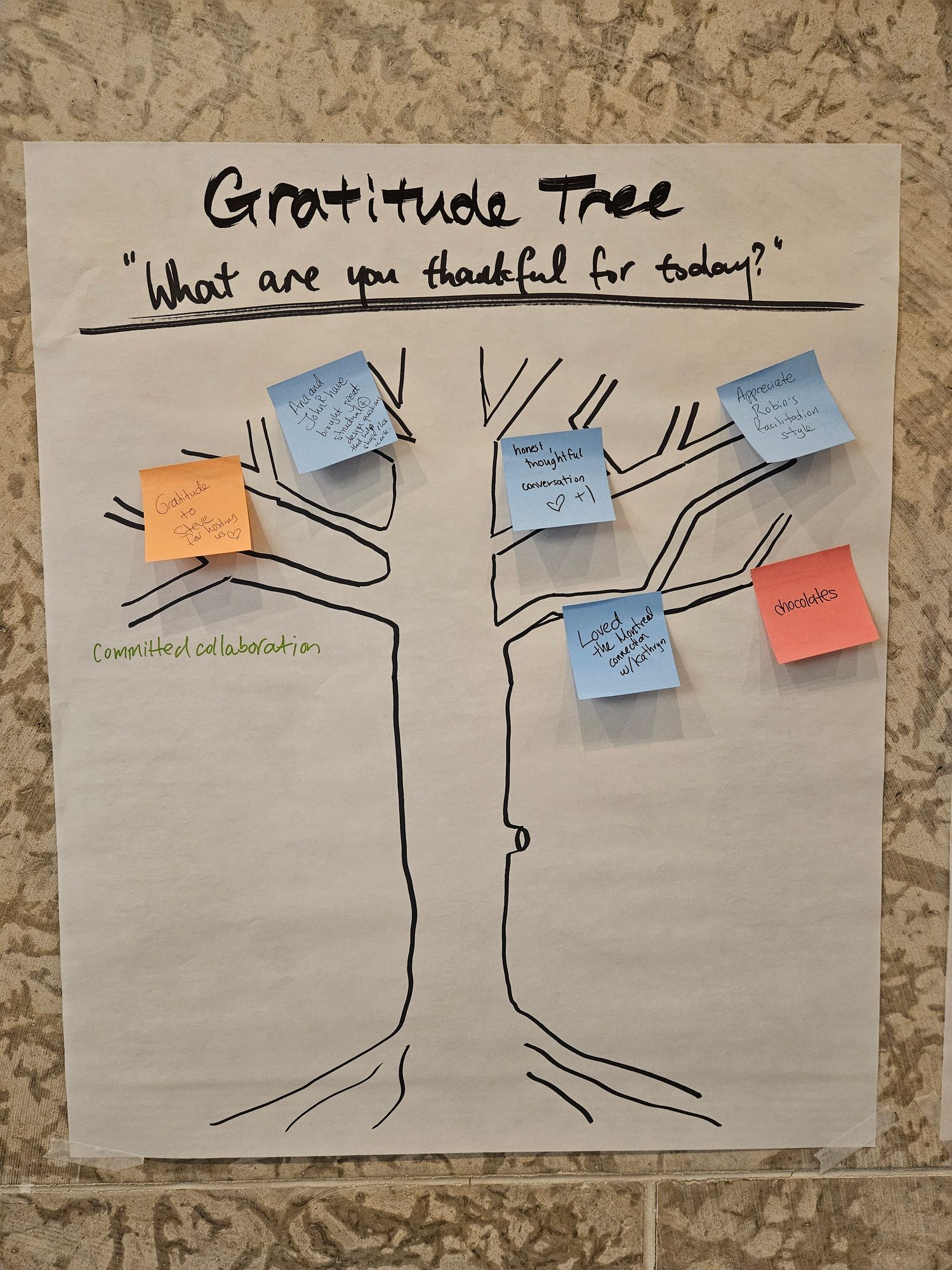
Three other sheets were on the wall all day. Their notes, as written:
- Gratitude tree ("What are you thankful for today?"), six notes: "Gratitude to Steve for hosting us" · "Ana and John R. have brought great structural design questions that help shape this work." · "honest, thoughtful conversation", with a heart and a +1 · "Appreciate Robin's facilitation style" · "Loved the Montreal connection w/Kathryn" · "chocolates". Written on the sheet: "Committed collaboration".
- Shout-outs ("Thank someone in this room, by name, with specifics"): written on the sheet, "SARAH YAFFE, ROBIN PREST: BEST CO-LEADS!" and "Odette + Umair: amazing teamwork". Two notes: "Steve's Leadership organization + RESEARCH" and "AMANDA".
- Quote wall ("What's the best line you heard today?"), one note: "Democracy is the solution to everything" ... "at least that's the promise".
In the closing round each person gave one sentence on what they were taking away. All 26, in the order they were said:
- "This was new to me, so yes. So I'm quite grateful to have been here and taken away lots of new connection, a new community, so many opportunities."
- "Let's do this. Like, I might be taking a bunch of work back with me, but in the best of way. So yeah, excited to see where this goes."
- "New connections and new ways of thinking about democracy."
- "Grateful for the generosity coming from the group."
- "Kindness and great facilitation will get you to the moon."
- "Grateful for the curiosity and the desire for action."
- "I feel like we're a power multiplier, so I'm excited."
- "I'm curious what's going to happen next, so taking away curiosity as well."
- "Energized by all the opportunities and just glad to be in space with all of you."
- "Very grateful and impressed with the progress we've made from where we were a year, year and a half ago. I did not think it was possible."
- "The power of co-design."
- "So many ideas and buzzing energy."
- "I'll echo what Robin said, together we're a power multiplier."
- "I mean, the one word that's on my mind is possibilities, possibilities, possibilities."
- "I noticed we didn't applaud you, Steve, so let me just take my moment to thank you."
- "Having seen democracy movements in a lot of other countries, it's very exciting to see one come together here."
- "My word is momentum."
- "I'm very grateful to have met everyone here yesterday and today, and very excited about the future."
- "I'm just really, really walking away with the momentum, as it's really encouraging and gives me a lot of, a lot of confidence moving forward."
- "Follow-up and agency."
- "Opportunity knocks."
- "Feeling really hopeful."
- "Just thankful to be here. Not to feel alone in this sector."
- "I'd say just echoing the gratefulness to the leaders of this initiative, and that we're stronger together."
- "Yeah, grateful for the new connections and friendships."
- "I'm also grateful for all of your trust and for showing up today and for your openness to this process, and a lot of gratitude to Steve, who herded the cats. But thank you all for being here. It's really nice to just be in the space with all of you."
The words that came up most in that round were gratitude, connection, momentum and possibility.
Then the closing words:
We were messy. [...] There's disagreements. I heard them. There's strong opinions. I would expect nothing less from a coalition. I would expect nothing less from democracy. The objective was never consensus, and it won't be consensus going forward. It's about working together.
We want to work together. We want to stop the silos across partisan line, across organizations, across funder networks and practitioner networks. So that is the win. We did it. We're gonna work together.
9 What happens next
What was decided or said on the day about what comes next.
- The name is the Canadian Democracy Network.
- Organizations are the voting members. Individuals can join as associates, without a vote.
- An independent body is to be incorporated now, to hold the coordination function, the contact list and any money. The transition team is to do this. By when was not decided.
- A transition team of the co-leads who want to continue carries the network forward, for up to two years.
- The co-leads meet before the end of the year to say who continues on the transition team.
- The notes on the draft principles go to the transition team for the next draft.
- The co-leads of each initiative contact the organizations that signed on to it. Fair Vote Canada leads the electoral reform initiative, and André Côté of The Dais leads tech accountability and the information ecosystem.
- The democracy between elections group said it would set up a shared drive and a way for members to communicate, starting the same week.
- Polity offered its online platform for group decision-making, so that work on governance can continue without meeting in person. The facilitator welcomed the offer for the transition team.
We will share a report of everything that came out of today with this group. We'll convene the co-leads to meet and continue talking. We know there's people that weren't here; we will continue to bring them into this group.
Not decided, and not discussed: when the network next meets.
10 How this record was made
The photos. The posters and sheets on the walls were photographed at the end of the day, and the counts here are read from those photos.
The counting. Each kind of reading was done twice, by two readers who did not see each other's work: the dots on the four questions, the principles, the sign-on sheets, and the walls and table sheets. The two readings agreed on every number and every organization. In two boxes a dot had moved or was covered by a note; there the facilitator's count on the day is used.
The recordings. Five recordings, 257 minutes in all, were transcribed on one laptop and nothing was sent to an outside service. The transcripts were then checked against the list of participants: names and terms corrected, nothing reworded. Quotes here are from those transcripts, word for word. Where words are left out inside a quote, the gap is marked [...]. A quote may start or stop partway through a sentence. The recordings cover the parts of the day when everyone was together. The opening, the speed introductions, the table conversations and lunch were not recorded. Eight lines of the closing round were hard to hear and are given as best heard.
What is left out. The speakers of quotes are not named. A few remarks about funders and about contacts with government are left out. Private contact details that appeared on one wall are not reproduced.
See the photos from the day, including the posters and sheets this record was read from.
Stay in the loop
Leave your name and email, and the network's transition team will write to you when there is more to say: how organizations and individuals can take part, and when the network meets next. Signing up does not make you or your organization a member.