The Canadian Democracy Network is founded
On Tuesday, November 10, 2026, 29 democracy organizations and independent practitioners from across Canada met for a day in Winnipeg. They founded the Canadian Democracy Network and signed on to 9 initiatives to work on together.
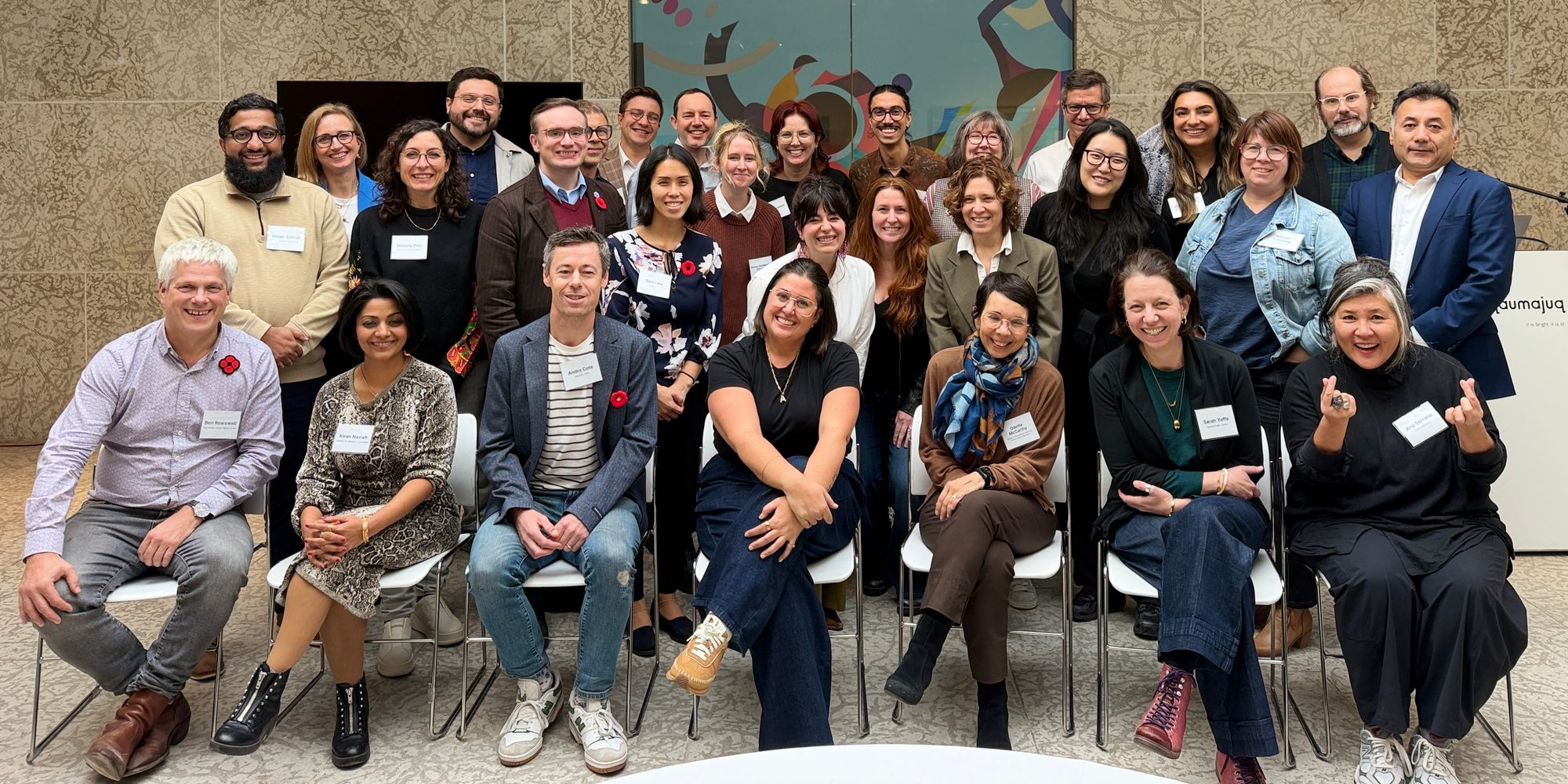
Who is in the photo: 29 people, from 27 organizations and 2 independent practitioners
- Apathy is Boring Sam Reusch
- Canadian Association of Journalists Brent Jolly
- The Canadian Muslim Vote Umair Ashraf
- CityHive Rowan Gentleman-Sylvester
- Coalition for Women in Journalism Kiran Nazish
- The Dais, Toronto Metropolitan University André Côté
- Democratic Engagement Exchange, Toronto Metropolitan University John Beebe
- Digital Public Square Shlomit Broder
- Equitas Odette McCarthy
- Fair Vote Canada Chris Mohan
- Independent Anna Miller
- Independent Victoria Kuketz
- Institut du Nouveau Monde Malorie Flon
- Investigative Journalism Foundation Zane Schwartz
- MASS LBP Chris Ellis
- MediaSmarts Kathryn Ann Hill
- New Majority Amanda Munday
- Nonprofit Chamber Alexa Briggs
- OCAD University Ana Serrano
- Paul Austin Human Rights Centre Ben Rowswell
- Polity John Richardson
- Resilient Societies Maiwand Rahyab
- Section 1 Dani Law
- SFU Morris J. Wosk Centre for Dialogue Robin Prest
- Strong Cities Network Eunhye Lee
- Tamarack Institute Jorge Garza
- Toronto Public Library Sarah Yaffe
- Volunteer Canada Megan Conway
- The Walrus Jennifer Hollett
What was decided
- The name
- The Canadian Democracy Network.
- Who belongs
- Organizations are the voting members. Individuals can join as associates, without a vote.
- How it is held
- An independent body will be incorporated now.
- Who carries it forward
- A transition team of the co-leads who want to continue, for up to two years.
The 9 initiatives
This is the work the network was founded to do. Each initiative began as a proposal from a working group or a member organization. Every one of the 29 organizations and independent practitioners in Winnipeg signed on to at least one, and those who signed on now take it forward together.
-
1. The civic learning pathway
Civic education in Canada is fragmented across provinces and territories, largely ends with secondary school, and has no shared framework. The civic learning pathway is a non-partisan framework for the democratic knowledge and skills Canadians need at each stage of life, from the early years into adulthood. Year one maps who does what and drafts the pathway. Year two publishes it and tests it in two or three settings, such as a school board and community organizations. Year three revises it, adds new pilots and a training module for educators. The estimated cost is about $1.38 million over three years, with one full-time pathway director and a steering committee of member organizations.
- Three years
- About $1.38 million (estimate)
-
2. A shared vision for the democracy we want
What kind of democracy do Canadians want, especially between elections? This initiative gathers the answer through events that member organizations already hold. The first step is a "dialogue in a box": agreed questions, packaged so that anyone can host a conversation and send in what they hear. Over the next three to six months, these dialogues run at democracy events and conferences across Canada. Within a year, the themes come back to the network to refine, and a first version of the vision is published for feedback. It is designed to build momentum with few resources.
- A first version within a year
Led by
Sarah Yaffe, Victoria Kuketz and Robin Prest
Signed on 16
- Apathy is Boring
- Canadian Association of Journalists
- CityHive
- Democratic Engagement Exchange
- Equitas
- Fair Vote Canada
- Institut du Nouveau Monde
- Investigative Journalism Foundation
- Polity
- Resilient Societies
- Section 1
- SFU Morris J. Wosk Centre for Dialogue
- Strong Cities Network
- Tamarack Institute
- Toronto Public Library
- Volunteer Canada
-
3. The network's purpose and actions
This initiative gives the network a clear common purpose and a plan of action, building on existing work and finding the gaps. The first step is a "good enough" set of principles to launch on. Over the next three to six months, the network's governing body works with members on its mission and vision. Within a year, the network publishes a purpose statement written with its members and brings them a draft strategy.
- A purpose statement within a year
Led by
Sarah Yaffe, Victoria Kuketz and Robin Prest
Signed on 15
- Apathy is Boring
- Canadian Association of Journalists
- Digital Public Square
- Institut du Nouveau Monde
- Investigative Journalism Foundation
- MASS LBP
- New Majority
- Paul Austin Human Rights Centre
- Polity
- Resilient Societies
- SFU Morris J. Wosk Centre for Dialogue
- Tamarack Institute
- Toronto Public Library
- Victoria Kuketz
- Volunteer Canada
-
4. Shared infrastructure: internal communications, resources, a toolkit
This initiative gives member organizations a common place to talk to each other and to share what they have. The first step is a shared drive and a communication platform, with members adding their own tools and resources and keeping them up to date. Over the next three to six months, members agree on categories, accessibility standards and who looks after what, and build a simple searchable directory. Within a year, the aim is the Everyday Democracy Toolkit: a public, searchable collection of resources, with someone responsible for its content, that organizations and in time the public can use all year.
- Starts now
- A public toolkit within a year
Led by
Sarah Yaffe, Victoria Kuketz and Robin Prest
-
5. A democracy festival
An idea for the network's second year and beyond: Canada's first democracy festival, as a launch and a celebration of what the network does. With it come a touring exhibit of real-life success stories of the democracy people want, and new gatherings in places the sector rarely goes, such as small-town community halls, libraries and legions. It builds on the first year's work on the vision, the purpose and the shared infrastructure. No date or budget has been set.
- Year two and beyond
Led by
Sarah Yaffe, Victoria Kuketz and Robin Prest
-
6. A public narrative about democracy
This initiative develops one shared public story about democracy and why it matters, then takes it to Canadians across the country, all year and not only at election time. The story is about democracy itself, not the sector, and is tested across the political spectrum. Each organization adapts it for its own audiences: "a songbook, not a script". Research and listening begin in January. Research and narrative development are estimated at $250,000 over eight to ten months, and the public campaign at $1 million over 18 months, with its reach growing with the investment.
- Research begins in January
- $250,000, then $1 million for the campaign (estimates)
Led by
Kiran Nazish and Shlomit Broder
-
7. Public investment in democracy
Democracy is a process, but it is funded as projects of one to three years. In the listening exercise that led to this network, 40 of 58 organizations called that a structural problem. No single source of money will fix it, so this initiative joins three strands into one strategy for durable, arm's-length funding: coordination with philanthropic funders through Democracy Funders Canada; the proposed Canadian Democracy Fund, a public endowment under discussion with the Government of Canada; and a blended model that combines public, philanthropic and private money. Within twelve months, the aim is three to five funders piloting multi-year core funding, and a first blended funding vehicle. Each strand needs three to five more members, at about six to eight hours a month.
- First pilots within twelve months
Led by
Anna Miller, Sam Reusch, Amanda Munday and John Beebe
Signed on 17
- Anna Miller
- Apathy is Boring
- Canadian Association of Journalists
- The Canadian Muslim Vote
- Coalition for Women in Journalism
- Democratic Engagement Exchange
- Digital Public Square
- Investigative Journalism Foundation
- MASS LBP
- New Majority
- Nonprofit Chamber
- Polity
- Resilient Societies
- Section 1
- Victoria Kuketz
- Volunteer Canada
- The Walrus
-
8. Electoral reform
Brought by Fair Vote Canada, a mostly volunteer-run, member-funded movement organization, which leads it. It starts from the network's founding question: what can organizations do together that they cannot do alone? It makes three invitations to the other members: to learning and dialogue about electoral reform, drawing on the resources Fair Vote Canada already has; to support, including presentations to their boards; and to collaboration.
Led by
Fair Vote Canada
Presented aloud on the day. There are no slides.
Signed on 2
-
9. Tech accountability and the information ecosystem
Work on tech accountability, social media regulation and the information ecosystem came just below the threshold for a working group of its own, but many member organizations are already active on it, alongside others who were not in Winnipeg. The main point of action is a bill on social media safety, introduced in June and now before Parliament. This initiative is for members to connect what they are doing: sharing information and coordinating.
Led by
André Côté of The Dais
Presented aloud on the day. There are no slides.
Signed on 3
What each group presented, and the questions and comments that followedThe whole sign-on grid
Who is not here yet
After lunch, each table took one group that was absent or thinly present: Indigenous organizations, conservatives, francophone Canada, the Prairies, the North and Atlantic Canada, and frontline communities. The question was what would have to be different about this network for those people to see it as worth their time.
The tables wrote down 40 ideas, and people put 20 suggestions on the wall for who should be here next time. They point to five things to do.
-
1. Say what we mean by "democracy"
7 ideas
The point made most often, and for three of the five groups. A shared vocabulary lets people see whether the invitation is for them. Some notes ask for an idea of democracy wider than the formal system.
- “Shared vocabulary of what we mean by democracy” Indigenous organizations
- “Clarify what we mean by ‘democracy’” Conservatives
- “Agreement/discussion on definition of democracy. Shared vocabulary” Conservatives
- “shared & accessible language & vocabulary” The Prairies, the North and Atlantic Canada
- “Spectrum of democracy: centralization, decentralization” Conservatives
- “Explore new/old modes of democracies that reflect Indigenous tradition” Indigenous organizations
- “Something to be explored around ‘imagining our democracy’” Indigenous organizations
-
2. Build the relationship first, with nothing asked
6 ideas
Take the time, listen, stay in conversation, and start by supporting work they already lead. The invitation comes after the relationship.
- “we need to take the time to build relationships without any associated ask. Stay in dialogue.” Indigenous organizations
- “Maybe we start by seeing how we support their work, as a first step.” Indigenous organizations
- “Trust + relationship” Indigenous organizations
- “Intentional listening (not performative)” Indigenous organizations
- “Building relationships over time” Indigenous organizations
- “Building (and highlighting) relationships before an invite” Conservatives
-
3. Go to them, through people they already know
6 ideas
Go to their events. Let members who already work with them vouch for the network. Invite Indigenous organizations as a group, not one at a time.
- “Attend and connect with people at conservative events (Canada Strong and Free & Manning Conference).” Conservatives
- “Using connections to vouch for the work, group.” The Prairies, the North and Atlantic Canada
- “invite a group of Cohort of indigenous organizations” Indigenous organizations
- “Engage Indigenous reps previously involved to get their views” Indigenous organizations
- “Invite right-wing non-profits, as identified by conservative funders (Rossy, Donner, Hunter Foundations) to this network's events.” Conservatives
- “Build more connections with civil liberties organizations.” Conservatives
-
4. Make the purpose and the principles clear
4 ideas
It is easier to invite people once the purpose, the principles and the governance are clear. For conservatives, the tables asked for a purpose statement that plainly includes conservative views.
- “Once we have clearer purpose + governance, easier to solicit participation.” Indigenous organizations
- “Purpose statement includes language that demonstrates explicitly being inclusive of conservative ideologies.” Conservatives
- “Clarity on our principles and be willing to work with people we disagree with.” Conservatives
- “Common goals” Conservatives
-
5. Put money behind taking part
2 ideas
Dedicated funding to take part was written for Indigenous organizations. One table said that for frontline communities the answer to an invitation may be yes at once if there is funding.
- “dedicated funding for participating in this group” Indigenous organizations
- “the fund should have reserved funding within the democracy fund for communities” Indigenous organizations
25 of the 40 ideas fall under these five, and every one of them is shown above.
The other 15 ideas: single points, questions and cautions
Indigenous organizations
- “Avoid over-indexing on the system as a focus”
- “Safety.”
Francophone Canada
- “Cultural connections (there is no ‘one’ Francophone community)”
- “Solidarity economy”
Conservatives
- “Learn from groups like D-Hub who bring diverse ideologies together.”
- “Do we understand why they don't want to participate?”
- “‘Othering conversation’”
- “there is a perception on the right that progressives are too ideological / cause-driven, too activist, veering away from a more narrow definition of liberal / constitutional democracy.”
- “Supporting interface service & dialogue”
The Prairies, the North and Atlantic Canada
- “rural focus”
- “traditional Knowledge systems”
- “address historic regional differences”
Frontline communities
- “Building belonging”
- “Community-led civic action”
- “Intersectionality”
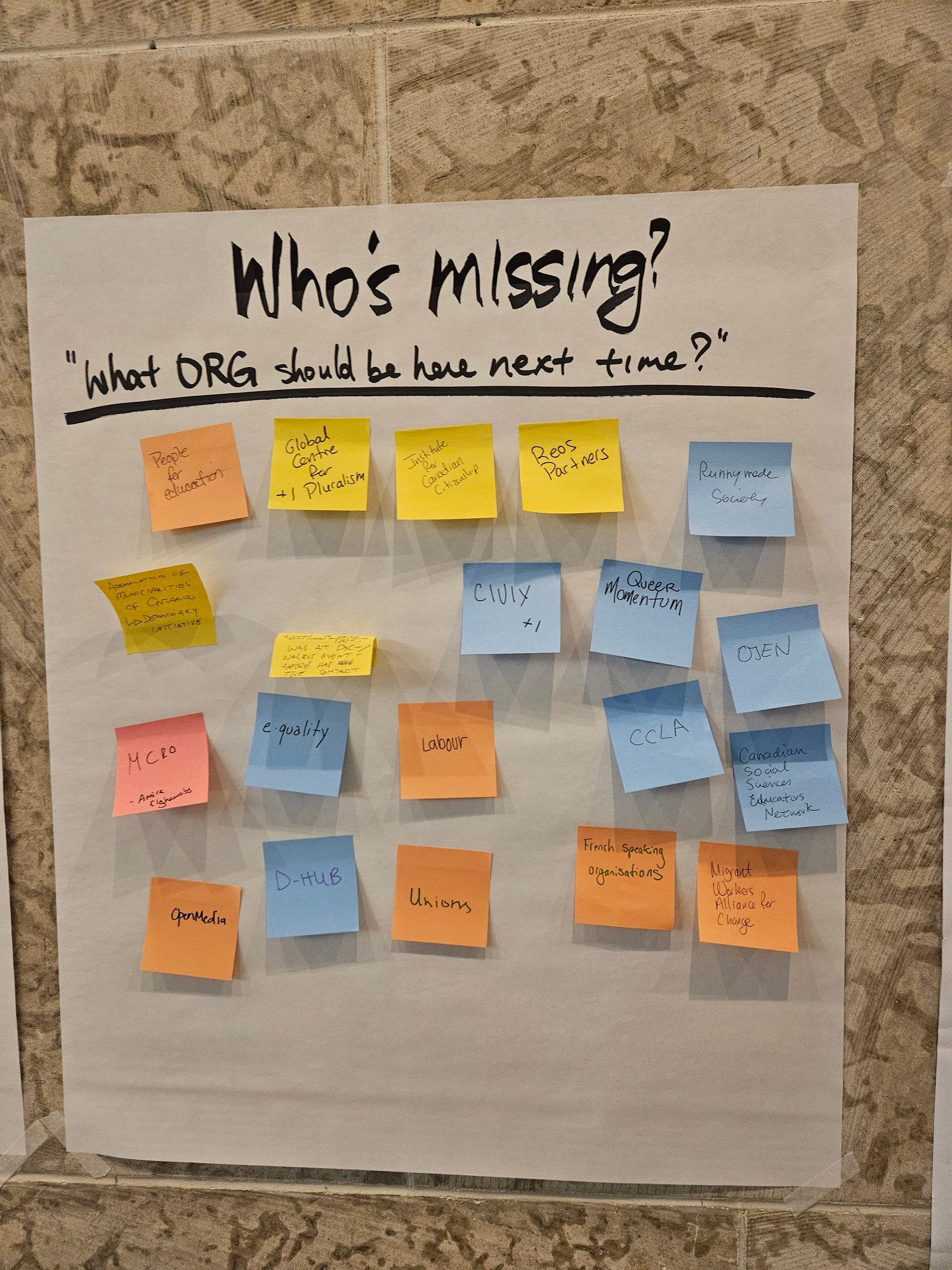
Who to ask: 20 suggestions from the wall
A sheet on the wall asked "What ORG should be here next time?" These are the 20 suggestions participants wrote. Nobody has approached these organizations yet.
- Canadian Civil Liberties Association
- CIVIX
- D-Hub
- Equality Fund
- Fish Flight Entertainment
- Global Centre for Pluralism
- Healthy Democracy Project, Association of Municipalities of Ontario
- Institute for Canadian Citizenship
- Migrant Workers Alliance for Change
- Muslim Communities Research Observatory
- Ontario Justice Education Network
- OpenMedia
- People for Education
- Queer Momentum
- Reos Partners
- Runnymede Society
- Social Studies Educators Network of Canada
- Labour
- Unions
- French-speaking organizations
What people took away
At the close, each person gave one sentence on what they were taking away. These are their words.
The words that came up most
- gratitude
- connection
- momentum
- possibility
One sentence each
“This was new to me, so yes. So I'm quite grateful to have been here and taken away lots of new connection, a new community, so many opportunities.”
“Let's do this. Like, I might be taking a bunch of work back with me, but in the best of way. So yeah, excited to see where this goes.”
“New connections and new ways of thinking about democracy.”
“Grateful for the generosity coming from the group.”
“Kindness and great facilitation will get you to the moon.”
“Grateful for the curiosity and the desire for action.”
“I feel like we're a power multiplier, so I'm excited.”
“I'm curious what's going to happen next, so taking away curiosity as well.”
“Energized by all the opportunities and just glad to be in space with all of you.”
“Very grateful and impressed with the progress we've made from where we were a year, year and a half ago. I did not think it was possible.”
“The power of co-design.”
“So many ideas and buzzing energy.”
“I'll echo what Robin said, together we're a power multiplier.”
“I mean, the one word that's on my mind is possibilities, possibilities, possibilities.”
“I noticed we didn't applaud you, Steve, so let me just take my moment to thank you.”
“Having seen democracy movements in a lot of other countries, it's very exciting to see one come together here.”
“My word is momentum.”
“I'm very grateful to have met everyone here yesterday and today, and very excited about the future.”
“I'm just really, really walking away with the momentum, as it's really encouraging and gives me a lot of, a lot of confidence moving forward.”
“Follow-up and agency.”
“Opportunity knocks.”
“Feeling really hopeful.”
“Just thankful to be here. Not to feel alone in this sector.”
“I'd say just echoing the gratefulness to the leaders of this initiative, and that we're stronger together.”
“Yeah, grateful for the new connections and friendships.”
“I'm also grateful for all of your trust and for showing up today and for your openness to this process, and a lot of gratitude to Steve, who herded the cats. But thank you all for being here. It's really nice to just be in the space with all of you.”
“We want to work together. We want to stop the silos across partisan line, across organizations, across funder networks and practitioner networks. So that is the win. We did it. We're gonna work together.”
10 of 27
Read all 27
- “This was new to me, so yes. So I'm quite grateful to have been here and taken away lots of new connection, a new community, so many opportunities.”
- “Let's do this. Like, I might be taking a bunch of work back with me, but in the best of way. So yeah, excited to see where this goes.”
- “New connections and new ways of thinking about democracy.”
- “Grateful for the generosity coming from the group.”
- “Kindness and great facilitation will get you to the moon.”
- “Grateful for the curiosity and the desire for action.”
- “I feel like we're a power multiplier, so I'm excited.”
- “I'm curious what's going to happen next, so taking away curiosity as well.”
- “Energized by all the opportunities and just glad to be in space with all of you.”
- “Very grateful and impressed with the progress we've made from where we were a year, year and a half ago. I did not think it was possible.”
- “The power of co-design.”
- “So many ideas and buzzing energy.”
- “I'll echo what Robin said, together we're a power multiplier.”
- “I mean, the one word that's on my mind is possibilities, possibilities, possibilities.”
- “I noticed we didn't applaud you, Steve, so let me just take my moment to thank you.”
- “Having seen democracy movements in a lot of other countries, it's very exciting to see one come together here.”
- “My word is momentum.”
- “I'm very grateful to have met everyone here yesterday and today, and very excited about the future.”
- “I'm just really, really walking away with the momentum, as it's really encouraging and gives me a lot of, a lot of confidence moving forward.”
- “Follow-up and agency.”
- “Opportunity knocks.”
- “Feeling really hopeful.”
- “Just thankful to be here. Not to feel alone in this sector.”
- “I'd say just echoing the gratefulness to the leaders of this initiative, and that we're stronger together.”
- “Yeah, grateful for the new connections and friendships.”
- “I'm also grateful for all of your trust and for showing up today and for your openness to this process, and a lot of gratitude to Steve, who herded the cats. But thank you all for being here. It's really nice to just be in the space with all of you.”
- “We want to work together. We want to stop the silos across partisan line, across organizations, across funder networks and practitioner networks. So that is the win. We did it. We're gonna work together.”
What happens next
-
The co-leads
Meet before the end of the year
The co-leads of the working groups meet, and each says whether they will continue on the transition team.
-
The leads of each initiative
Bring together the organizations that signed on
They contact everyone who signed on and set up a first meeting. Each group takes its initiative from there. Fair Vote Canada does this for electoral reform, and André Côté of The Dais for tech accountability and the information ecosystem.
-
The transition team
Set up the network
- Incorporate the independent body.
- Write the next draft of the principles. The draft principles drew 22 notes in a straw poll, and the notes go to the team.
- Bring in who is not here yet, starting from the five things above.
- Set when the network meets next.
- The full recordEverything that was said and counted, in numbered paragraphs: how each decision was reached, what each group presented and the questions and comments that followed, the draft principles and their notes, and the walls.
- 48 photos from the dayThe people, the tables, and every poster and sheet this report was read from.
Stay in the loop
Leave your name and email, and the network's transition team will write to you when there is more to say: how organizations and individuals can take part, and when the network meets next. Signing up does not make you or your organization a member.